Difference between revisions of "Émilien Bouglione"
From Circopedia
(→Image Gallery) |
(→Image Gallery) |
||
| Line 78: | Line 78: | ||
File:Les_Frères_Bouglione.jpg|The Bouglione Brothers (c.1950) | File:Les_Frères_Bouglione.jpg|The Bouglione Brothers (c.1950) | ||
File:Bouglione_-_Avedon.jpg|Émilien Bouglione by Richard Avedon (1955) | File:Bouglione_-_Avedon.jpg|Émilien Bouglione by Richard Avedon (1955) | ||
| + | File:Emilien_Bouglione_by_Avedon.jpg|Émilien Bouglione by Richard Avedon (1955) | ||
File:Emilien_Bouglione_Avedon.jpg|Émilien Bouglione, Mylos, and Dovina by Richard Avedon (1955) | File:Emilien_Bouglione_Avedon.jpg|Émilien Bouglione, Mylos, and Dovina by Richard Avedon (1955) | ||
File:Emilien_Bouglione.jpg|Émilien Bouglione and his horses (c.1965) | File:Emilien_Bouglione.jpg|Émilien Bouglione and his horses (c.1965) | ||
Revision as of 19:42, 25 March 2026

Equestrian, Circus Director
by Raffaele De Ritis
Émilien Bouglione (1934-2026) was the fourth of Joseph and Rosa Bouglione’s seven children (Odette, 1929-2025 – Josette, 1930-? – Firmin, 1933-2022 – Émilien – Sandrine, 1936-2012 – Sampion III, 1938-2019 – Joseph, b. 1942). Of the four brothers, he was by far the most artistically minded; he succeeded his uncle Sampion II at the helm of Cirque Bouglione’s equestrian department and presented with infinite taste and great gusto equestrian presentations that were often prepared with the help of his mentor, Master Equestrian André Vasserot (1911-1991).
The Bouglione Family
He was born Jules Émilien Buffalo-Bill Bouglione on July 20th, 1934, in Coulommiers (a town famous for its cheese, east of Paris), where the circus was performing. His father, the legendary circus director Joseph Bouglione (1904-1987), and his Belgian mother, Rosalie Van Been (1910-2018), were both of Roma descent and came from the world of fairground menageries, which were, between the two world wars, restructuring into the modern traveling circus.
The father and uncles of "Julot" (the diminutive by which Emilien was known by his close friends and family) had already paraded under a succession of picturesque banners—including one that helped them build their fortune: Stade Bufalo-Bill—before settling on the proud Cirque des 4 Frères Bouglione. It is said that the day after their newest family member, Jules Émilien, had arrived, they signed the contract making them tenants of the Cirque d'Hiver in Paris, the world's oldest circus building, which eventually became their property.
The Bougliones were a large family whose school had been the circus ring. Emilien entered it at the age of two and was already in the saddle two years later. Like in every circus, the Bougliones' ring was a school of life, the curriculum of which was written in the pungent smell of horse manure, wild animals, leather, and sawdust. Their approach to equestrian art owed nothing to the classical academic style (already fading away): Theirs was fierce and more romantic; it was the world of mythical horses that gallop through folklore and dime novels, ridden by a family whose Roma blood gave it a stamp of dazzling wonder.
Émilien made his official debut in 1943, billed as "Le plus jeune cavalier de France" (The Youngest Horseman in France"), under the tutelage of Achille Zavatta, a celebrated clown and one of the most protean figures the circus world ever produced. Young Émilien, however, had already been used in small parts in the pantomimeA circus play, not necessarily mute, with a dramatic story-line (a regular feature in 18th and 19th century circus performances). Blanche-Neige ("Snow White")—one of the innovative circus operettas the Bougliones staged with the Géo Sandry, their conceptor and director, during the German occupation to uplift the Parisians' spirits.
To Émilien, this experience had been a useful training in theatricality and showmanship. He also appeared in small parts with some of the great clowns of the times, who rotated through the Bougliones' circus rings with the reliability of a well-maintained mechanism. After the war, during school holidays, he began to familiarize himself with his uncle Sampion's cavalerie(French) The ensemble of the horses in an equestrian circus; a group of horses presented "at liberty.": seven Ukrainian stallions, which he eventually took over in 1950.
The Family's Star
What followed was the making of Émilien Bouglione, the Circus Icon. He had true ambitions as a circus artist, which quickly found their shape in La Poste ("The CourierAn equestrian presentation created by Andrew Ducrow in 1827 as ''The Courier of St. Petersburg'', in which a rider stands on two galloping horses, one foot on each, and allows other horses to pass between his mounts, catching their reins as they pass, eventually holding the reins a group of galloping horses in front of him. (Also known in French as ''La Poste''.)")—that vertiginous equestrian presentation created in the 19th century by Andrew Ducrow, in which a rider stands astride two horses at full gallop while a half-dozen stallions pass at great speed between his legs, the rider catching their unfolding long reins one by one before controlling a full galloping atelage. Émilien presented it first in a cowboy costume, then as Zorro, and finally in the Roman attire of Ben-Hur, grasping the coattails of Hollywood with a confidence that Hollywood itself might have envied.
Dividing its activities between Paris's Cirque d'Hiver and its tours throughout France, Belgium, and The Netherlands (with a foray in Brazil), the Bouglione circus gave Émilien the opportunity to try his hand at everything, from acrobatics to the family's specialty, animal training—which had included the presentation of his uncle Firmin's mixed group of tigers, lions and leopards, as well as the Bouglione elephants&mash;and even standing in for a human cannonball when the occasion demanded. But horsemanship remained his true domain, the medium through which his inexhaustible imagination found its expression.
Assisted by the indispensable André Vasserot, Émilien assembled rich stables and developed a style at once lively and precise: large groups of mixed breeds—Anglo-Arabs, Norwegians, ponies—freed from the rigid stylizations of the classical school, often presented with his personal trademark: riding a magnificent horse, always in a superb costume, and sometimes sitting on an ornate Mexican saddle: As opposed to his father and his uncles, who often appeared in the ring (and in the cage) in the suit they wore in town, Émilien had a keen sense of style and a true elegance that served his outstanding showmanship.
Whether conducting his cavalerie(French) The ensemble of the horses in an equestrian circus; a group of horses presented "at liberty." or in the evolutions of The CourierAn equestrian presentation created by Andrew Ducrow in 1827 as ''The Courier of St. Petersburg'', in which a rider stands on two galloping horses, one foot on each, and allows other horses to pass between his mounts, catching their reins as they pass, eventually holding the reins a group of galloping horses in front of him. (Also known in French as ''La Poste''.), he moved through a gallery of identities that had thrilled twentieth-century imaginations: Robin Hood, a Sioux chief, Zorro, Davy Crockett, a Mexican charro, an oriental prince, an Argentinean gaucho, a gladiator, an Andalusian vaquero. His costumes and orchestral choices were always of the highest order, and his charisma became, by then, undeniable. He had managed to distil the spirit of popular literature and film into immediate scenic art, and the ring was his medium.
The 1960s marked the apotheosis of the Technicolor adventure film, and an intensely busy period for the Bouglione family. In 1963, they took over Paris's Cirque de Montmartre (formerly Medrano), which was placed under the management of the "Bouglione Juniors" (Firmin, Émilien, Sampion, Joseph) while, starting at the end of the 1950s, the Cirque d'Hiver began hosting the extremely popular and long-running television circus show ''La Piste aux Étoiles''. For more than twenty years, that show gave Émilien an extraordinary exposure, not only of him to the French public, but for him personally to television techniques and to a remarkable and diverse assortment of talented artists. He was a quick study.
A Man of The World
Endowed with a natural elegance in and outside the ring, Émilien had social gifts and interests that surprised those who expected a circus man to limit his world to the sole circus. He could converse with anyone on many subjects—brilliant and modest in equal measure—and he developed, with some apparent ease, friendships well beyond the world of sawdust. He retained all the while the mysterious charm of the nomad: impossible to fully explain, impossible to dismiss.
Naturally at ease in all social groups, he became friends with Salvador Dalí. In 1955, he sat for the legendary photographer Richard Avedon, who made pictures of him now preserved in major museums worldwide. In the 1970s, the Cirque d'Hiver began to host a new cycle of the annual Gala de l'Union des Artistes (the original inspiration for all subsequent "Circus of The Stars", originated in 1923 at Paris's Nouveau Cirque), one of the most glittering Parisian events of the twentieth century.
Émilien collaborated on its direction, and year after year handed his chambrière(French) Long whip customarily used by Equestrians for the presentation of horses "at liberty." and his horses to the likes of Gina Lollobrigida (whom, at age seventeen, he had met on the set of the film Trapeze [1956], which was shot at the Cirque d'Hiver), the legendary Italian film director and actor Vittorio De Sica, and one of Paris's brightest stars, Josephine Baker. His circle of friends also included Charles Aznavour, Alain Delon, Jean-Paul Belmondo, the legendary chef Paul Bocuse, and the jazzman Lionel Hampton, among many others.
For his magnificent and elegant stage costumes, he once turned to Paco Rabanne. He paid the same attention to his harnesses and his saddles: Memorable above all was the majestic silver-inlaid saddle-armor on which, wearing a gold-sequined bolero jacket over a black gilet and black pants, Émilien was portrayed by the great Italian illustrator Renato Casaro for a magnificent two-sheet poster of 1976— the image of a man entirely comfortable in his own legend.
Award-Winner and Collector: The Circus Prince
In 1974, the Bougliones put their traveling circus at the disposal of Monaco's Prince Rainier III to host and organize the first International Circus Festival of Monte Carlo. Émilien entered his liberty"Liberty act", "Horses at liberty": Unmounted horses presented from the center of the ring by an equestrian directing his charges with his voice, body movements, and signals from a ''chambrière'' (French), or long whip. act in the competition and took home a Silver Clown—the first ever awarded. In many of his equestrian acts, he was accompanied by his wife, the beautiful Christiane Bouglione, née Hernandez, who would eventually produce her own shows, and who gave him four children, Odette, Regina, Joseph, and Louis-Sampion.
The Cirque Bouglione quit traveling in 1981, and a few years later the Cirque d'Hiver also abandoned its circus season, becoming a theater-for-hire. Émilien then turned to his lifelong passion: collecting. He accumulated, with methodical fervor, an astonishing trove of art objects—paintings, bronzes, various memorabilia, documents related to the circus and the equestrian world—helping to reconstruct in the process parts of circus history that might otherwise have disappeared.
In 1999, together with his mother and his brother Sampion III, he gave his blessing to a decision to entrust the Bougliones' next generation with reviving the Cirque d'Hiver's circus season. Émilien's own role in the project was unique and impossible to define precisely: that of an inspiring spirit. His presence alone lent quiet authority to an experiment that became, over the years, one of the most remarkable successes in the circus world, in large part thanks to Émilien's own children.
In the first decades of the twenty-first century, anyone who happened to pass through the Cirque d'Hiver at any hour of the day could easily find themselves face to face with the silhouette of "Monsieur Émilien," who had become the family patriarch, emerging unexpectedly from one of the house's vomitorums, or from some mysterious corridor, or any one of the numerous age-old little doors that the venerable building seems to multiply at will.
His lean figure moved silently and discreetly—and, invariably, his impeccable elegance struck you: his magnificent waistcoats, coordinated with tie or foulard, emblazoned cufflinks glinting at the wrists. It was less the flamboyance of a retired circus veteran than the grace of an emeritus sovereign. Yet there was nothing intimidating about him. A gentle familiarity established itself at once, and the conversation (one might find oneself drawn into circus lore, fine arts, current affairs, a grandchild passing by, some neglected detail in a corner) burned with a quiet, fervent passion.
Epilogue
Little by little, Émilien's children took over the full management of the Cirque d'Hiver. Joseph had been the shows' very talented artistic director since the Cirque d'Hiver had resumed its circus activities, assisted by his sister Regina, who oversees the look and elegant wardrobe of artists and personnel. Louis-Sampion, who shared his father's passion for history and collecting, created the private Musée Émilien Bouglione in the Cirque d'Hiver, and makes sure the cultural and historical values of the legendary Parisian building are appreciated and safeguarded. Finally, Odette became CEO of the entire Bouglione organization. They all share with their father elegance, talent, and a committed respect for the place of their family in circus history.
Émilien Bouglione passed away in Paris on March 15, 2026; he was ninety-two. His funeral service was held at the Église Saint-Roch, rue St. Honoré in Paris, and was attended by a large crowd of friends, circus professionals, and admirers. Le Prince du Cirque ("The Circus Prince"), as he was often called, joined two previous generations of his ancestors in the Bouglione dynasty's mausoleum at the cemetery of Lizy-sur-Ourq, near Paris. Émilien Bouglione was one of those beloved personalities thanks to whom the word "circus" continues to evoke fascination and legend rather than mere nostalgia.
Suggested Reading
- Pascaline Kromicheff, Émilien Bouglione, Prince du Cirque (Puits, De la Voix au Chapitre, 2019) — ISBN 978-2-9562209-1-6
See Also
- Biography: The Bouglione Family
- Video: Emilien Bouglione, Norwegian horses, at the Cirque d'Hiver (1962)
- Video: Emilien Bouglione, liberty act, at the Cirque d'Hiver (1963)
- Video: Emilien Bouglione, La Poste, at the Cirque d'Hiver (1966)
- Video: Emilien Bouglione, La Poste, at the Cirque d'Hiver (1969)
- Video: Émilien Bouglione, liberty act, at Chipperfield's Circus (1974)
Image Gallery
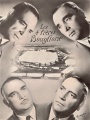
The Bouglione Brothers (c.1950)
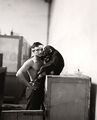
Émilien Bouglione by Richard Avedon (1955)
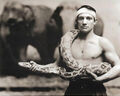
Émilien Bouglione by Richard Avedon (1955)
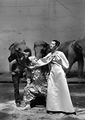
Émilien Bouglione, Mylos, and Dovina by Richard Avedon (1955)
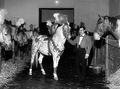
Émilien Bouglione and his horses (c.1965)
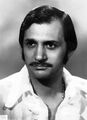
Émilien Bouglione (c.1970)
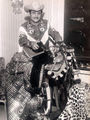
Émilien Bouglione with his Mexican saddle (c.1970)
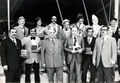
Émilien Bouglione and Family in Monte Carlo (1974)


