Difference between revisions of "Cirque Bureau"
From Circopedia
(→2. JULES GLASNER'S CIRQUE BUREAU) |
(→Image Gallery) |
||
| (58 intermediate revisions by the same user not shown) | |||
| Line 1: | Line 1: | ||
| − | + | {{Languages}} | |
| + | |||
''By Dominique Jando'' | ''By Dominique Jando'' | ||
| − | From the late nineteenth century to the early 1950s, the Cirque Bureau was one of France's most popular circuses. Over its long existence, it had built in the French provinces a faithful audience that appreciated the constant high quality of its offerings and its simplicity, devoid of the advertising hype of its competitors. Wherever it went, its visits were expected and anticipated, practically at the same time each year. Sadly, this steady routine was disturbed by World War II and the Nazi occupation of France—and Jules Glasner, its last director, had a hard time trying to restore its place in the new economic era that followed the war: The Cirque Bureau folded its big top in 1953, at the end of what was advertised as its "99th season." | + | [[File:Bureau_Program_Cover.jpg|right|350px]]From the late nineteenth century to the early 1950s, the Cirque Bureau was one of France's most popular circuses. Over its long existence, it had built in the French provinces a faithful audience that appreciated the constant high quality of its offerings and its simplicity, devoid of the advertising hype of its competitors. Wherever it went, its visits were expected and anticipated, practically at the same time each year. Sadly, this steady routine was disturbed by World War II and the Nazi occupation of France—and Jules Glasner, its last director, had a hard time trying to restore its place in the new economic era that followed the war: The Cirque Bureau folded its big top in 1953, at the end of what was advertised as its "99th season." |
| − | ==1. BUREAU BROTHERS' CIRCUS== | + | |
| + | ==1. THE BUREAU BROTHERS' CIRCUS== | ||
Its founder was Jean Bureau (1836-1899), born on May 31, 1836, in Villeréal, a small village of the Lot et Garonne department that has kept its medieval architecture and is classified today as one of the "most beautiful villages of France." His father, Jean, Sr. (1809-1844), a carpenter and the son of a farmer, and his mother, Françoise (née Arché, 1815-1880), had two other children: Cosme (1838-1885) and Jeanne (1844-1908). Jean Bureau was just eight years old when he lost his father, and to alleviate the burden on his family, he was soon placed in apprenticeship to a blacksmith. | Its founder was Jean Bureau (1836-1899), born on May 31, 1836, in Villeréal, a small village of the Lot et Garonne department that has kept its medieval architecture and is classified today as one of the "most beautiful villages of France." His father, Jean, Sr. (1809-1844), a carpenter and the son of a farmer, and his mother, Françoise (née Arché, 1815-1880), had two other children: Cosme (1838-1885) and Jeanne (1844-1908). Jean Bureau was just eight years old when he lost his father, and to alleviate the burden on his family, he was soon placed in apprenticeship to a blacksmith. | ||
| + | |||
| + | ===The Tagg Family=== | ||
In 1853, a small traveling equestrian circus came to Villeréal. It was a modest affair owned by William Tagg (1822-1884), and his wife Elizabeth, née Woodley, a couple of British traveling performers who had long settled in France. The Taggs needed a blacksmith to reshoe their horses, and his boss sent seventeen-year-old Jean Bureau, a horse lover, to do the job. Jean was immediately fascinated by these people whose horizon seemed limitless; he asked William Tagg if he could join the company as a groom—and the Taggs, whose human resources were probably wanting, left Villeréal with Jean in tow. | In 1853, a small traveling equestrian circus came to Villeréal. It was a modest affair owned by William Tagg (1822-1884), and his wife Elizabeth, née Woodley, a couple of British traveling performers who had long settled in France. The Taggs needed a blacksmith to reshoe their horses, and his boss sent seventeen-year-old Jean Bureau, a horse lover, to do the job. Jean was immediately fascinated by these people whose horizon seemed limitless; he asked William Tagg if he could join the company as a groom—and the Taggs, whose human resources were probably wanting, left Villeréal with Jean in tow. | ||
| − | Thus, Jean Bureau had started his circus career. Young, athletic, and interested in horsemanship, he trained in trick-riding and quickly became a proficient bareback rider. Having become a full-fledged performer in the company, he began to pay attention to the young Anna Tagg (1840-1913), the director's daughter, who was born in Paris and was four years his junior. Apparently, the feeling was mutual—to the extent that, | + | Thus, Jean Bureau had started his circus career. Young, athletic, and interested in horsemanship, he trained in trick-riding and quickly became a proficient bareback rider. Having become a full-fledged performer in the company, he began to pay attention to the young Anna Tagg (1840-1913), the director's daughter, who was born in Paris and was four years his junior. Apparently, the feeling was mutual—to the extent that, on November 18, 1862, Anna gave birth to their first child, Françoise Elizabeth (known as Elizabeth) in Bergerac (Dordogne). It was time indeed to legalize their union: The young couple was married on March 6, 1863, in Cenon, in the outskirts of Bordeaux. By then, Jean was twenty-seven and Anna, twenty-three. |
This sequence of events begs a question: When was Jean Bureau's own circus really created? According to a later tradition, the Cirque Bureau was "founded in 1854 by Jean and Anna Bureau," but at that date, if Jean was eighteen, Anna Tagg was only fourteen. However, Jean's usefulness as a groom-blacksmith-cum-performer was precious in this small family circus: It is possible indeed that the Taggs considered him as the son and heir they didn't have and accepting him in the family was akin to give him a co-ownership. | This sequence of events begs a question: When was Jean Bureau's own circus really created? According to a later tradition, the Cirque Bureau was "founded in 1854 by Jean and Anna Bureau," but at that date, if Jean was eighteen, Anna Tagg was only fourteen. However, Jean's usefulness as a groom-blacksmith-cum-performer was precious in this small family circus: It is possible indeed that the Taggs considered him as the son and heir they didn't have and accepting him in the family was akin to give him a co-ownership. | ||
| − | According to records, Jean Bureau began to operate under the title "Cirque Bureau" around 1884, having used several different names prior to that year. Jean and Anna did not marry until 1863, following the birth of their first child in 1862, which means they were not yet a legitimate couple in 1854—not to mention Anna’s age at the time. Given these details, it is reasonable to interpret the year 1854 as marking Jean Bureau’s debut as a circus performer and, possibly, as a co-director of the Taggs’ circus enterprise. | + | According to records, Jean Bureau began to operate under the title "Cirque Bureau" around 1884, having used several different names prior to that year. Jean and Anna did not marry until 1863, following the birth of their first child in 1862, which means they were not yet a legitimate couple in 1854—not to mention Anna’s age at the time. Given these details, it is reasonable to interpret the year 1854 as marking Jean Bureau’s debut as a circus performer and, possibly, as a co-director of the Taggs’ circus enterprise. |
===From Cirque Bordelais to Grand Cirque Bureau=== | ===From Cirque Bordelais to Grand Cirque Bureau=== | ||
| Line 22: | Line 26: | ||
Be as it may, at some point Jean and Anna Bureau created their own circus. It was probably with the equipment of the Taggs, who may have left it to the young couple—which would further explain the date of 1854 as the Cirque Bureau's creation: Jean and Anna's first circus may have been a mere continuation of the Taggs' circus. However, the Bureaus' circus was still a modest traveling enterprise that needed to grow, and Jean asked his brother Cosme to come and help him run and develop it. | Be as it may, at some point Jean and Anna Bureau created their own circus. It was probably with the equipment of the Taggs, who may have left it to the young couple—which would further explain the date of 1854 as the Cirque Bureau's creation: Jean and Anna's first circus may have been a mere continuation of the Taggs' circus. However, the Bureaus' circus was still a modest traveling enterprise that needed to grow, and Jean asked his brother Cosme to come and help him run and develop it. | ||
| − | At first, their company worked under various names | + | At first, their company worked under various names, as it generally happened with traveling circuses whose owners' name was not well established enough to attract an audience—or when the owners didn't want their name to be associated with some challenging situations that might turn to their disadvantage. The first mention of a circus managed by the Bureaus was in 1876: It was the ''Cirque Bordelais'', which suggests that the Bureaus had remained in the region originally visited by the Taggs, and where Jean came from (i.e. the Bordelais, which is the region of Bordeaux and its environs). |
The Cirque Bordelais was not hiding its identity anymore: it was clearly advertised under the management of the brothers Bureau and "Joanny Fils ainé" (Joanny, Jr. the elder). Joanny was the pseudonym used by an old Italian family of traveling entertainers, the Magrinis; as an experienced professional, Joanny Fils must have helped the Bureaus to develop their enterprise. They now performed in a "construction," a wooden circus that was built, dismantled, and rebuilt in the towns they visited (usually for extended periods, such as a local fair), as was the custom for many traveling companies in the 19th century. | The Cirque Bordelais was not hiding its identity anymore: it was clearly advertised under the management of the brothers Bureau and "Joanny Fils ainé" (Joanny, Jr. the elder). Joanny was the pseudonym used by an old Italian family of traveling entertainers, the Magrinis; as an experienced professional, Joanny Fils must have helped the Bureaus to develop their enterprise. They now performed in a "construction," a wooden circus that was built, dismantled, and rebuilt in the towns they visited (usually for extended periods, such as a local fair), as was the custom for many traveling companies in the 19th century. | ||
| Line 32: | Line 36: | ||
Thus, within a few decades, the Bureaus had already left a visible footprint in the circus world! Their large tribe formed the backbone of the Cirque Bureau's shows for several years. In a typical program, audiences could see Achille Conche juggling and doing a musical entrée with his brothers; Ferroni performing a double jockey act with Joseph Bureau, while Paul Bureau, as a clown under the name of Popol, presented a bullfight parody; Ninie Bureau was a bareback rider; Marguerite Bureau, a ballerina on horseback—to whom where added other family members and contracted acts. The entire company would appear in a classic pantomime in the second part of the show. | Thus, within a few decades, the Bureaus had already left a visible footprint in the circus world! Their large tribe formed the backbone of the Cirque Bureau's shows for several years. In a typical program, audiences could see Achille Conche juggling and doing a musical entrée with his brothers; Ferroni performing a double jockey act with Joseph Bureau, while Paul Bureau, as a clown under the name of Popol, presented a bullfight parody; Ninie Bureau was a bareback rider; Marguerite Bureau, a ballerina on horseback—to whom where added other family members and contracted acts. The entire company would appear in a classic pantomime in the second part of the show. | ||
| − | + | ===Le Cirque Bureau Frères=== | |
| − | + | On December 27,1898, Marguerite's husband, Fortuné Ferroni, died from a bad fall in Brive-la-Gaillarde (in Auvergne) after trying to turn a somersault on horseback with his two feet attached in a basket—an old equestrian classic, albeit neither easy nor safe! Marguerite and Fortuné had had four children: Louis Georges (1887-1974), Annetta (Known as Anna, 1891-1958), César (1893-1894), and Robert Joseph (1896-1922). The Ferroni lineage holds a great importance in the Cirque Bureau's history, as it will ultimately be Annetta’s responsibility, several decades later, to maintain its continuity and keep it in the family. | |
Jean Bureau retired in 1896 and left the management of his circus to his sons Joseph and Paul. He passed away three years later, on October 31, 1899, in Saint-Amand-Montrond, a small town in the Centre department of France (where the circus was probably playing). Jean Bureau was sixty-three. By 1909, the Cirque Bureau traveled by horsepower with a two-pole big top—although it still used its ''construction'' for the big fairs it visited each year. It had also adopted electric lighting: The ''Cirque Bureau Frères'' had entered a new era. | Jean Bureau retired in 1896 and left the management of his circus to his sons Joseph and Paul. He passed away three years later, on October 31, 1899, in Saint-Amand-Montrond, a small town in the Centre department of France (where the circus was probably playing). Jean Bureau was sixty-three. By 1909, the Cirque Bureau traveled by horsepower with a two-pole big top—although it still used its ''construction'' for the big fairs it visited each year. It had also adopted electric lighting: The ''Cirque Bureau Frères'' had entered a new era. | ||
| Line 44: | Line 48: | ||
Then, Joseph Bureau's health began to decline—to the point that he eventually had to leave the circus and enter a sanatorium in Leysin, in Switzerland, where the circus had been showing in 1909. He died there on November 30, 1911, at age forty-four. Having never married, he had no descendance. The management of the company was left to his brother Paul and his sister, Marguerite Ferroni. | Then, Joseph Bureau's health began to decline—to the point that he eventually had to leave the circus and enter a sanatorium in Leysin, in Switzerland, where the circus had been showing in 1909. He died there on November 30, 1911, at age forty-four. Having never married, he had no descendance. The management of the company was left to his brother Paul and his sister, Marguerite Ferroni. | ||
| − | On July 27, 1913, Anna Tagg-Bureau, co-founder of the circus, passed away in Angouleme (Charente) at age seventy-three. But a happier and momentous event had occurred on February 12 of the same year in Nevers (in the center of France, where the circus was playing): Anneta Ferroni, better known as Anna, Marguerite's daughter, had married the talented animal trainer Jules Glasner (1883-1962). | + | On July 27, 1913, Anna Tagg-Bureau, co-founder of the circus, passed away in Angouleme (Charente) at age seventy-three. But a happier and momentous event had occurred on February 12 of the same year in Nevers (in the center of France, where the circus was playing): Anneta Ferroni, better known as Anna, Marguerite's daughter, had married the talented animal trainer [[Jules Glasner]] (1883-1962). |
===Enter Jules Glasner=== | ===Enter Jules Glasner=== | ||
| Line 77: | Line 81: | ||
Since the end of the war, Jules Glasner and his wife, Anna, had become increasingly involved in the circus's day-to-day management—he, taking care of its technical and artistic aspects, and she, of its administrative chores. Until 1923, the printed programs had mentioned Paul Bureau as the circus's "sole director." The following year, his name disappeared, and Jules Glasner appeared with the title of "Administrateur-Général" (General Manager). Paul Bureau passed away on May 3, 1925, in Saint-Mandé, a Paris suburb; he was only fifty-three and, like his brother Joseph, he had never married and had no descendance. | Since the end of the war, Jules Glasner and his wife, Anna, had become increasingly involved in the circus's day-to-day management—he, taking care of its technical and artistic aspects, and she, of its administrative chores. Until 1923, the printed programs had mentioned Paul Bureau as the circus's "sole director." The following year, his name disappeared, and Jules Glasner appeared with the title of "Administrateur-Général" (General Manager). Paul Bureau passed away on May 3, 1925, in Saint-Mandé, a Paris suburb; he was only fifty-three and, like his brother Joseph, he had never married and had no descendance. | ||
| − | + | ||
==2. JULES GLASNER'S CIRQUE BUREAU== | ==2. JULES GLASNER'S CIRQUE BUREAU== | ||
| Line 88: | Line 92: | ||
Jules and Anna Glasner were careful not to change what had made the Cirque Bureau's reputation: programs of high quality in a circus that didn't pretend to be something it was not. This basic honesty, which was not always shared by its competitors, was the reason of its continuous success. The Cirque Bureau was not the biggest nor the flashiest, and its owners never amassed a sizeable fortune, but it had always been financially sound, and the best acts didn't hesitate signing contracts with a circus whose business was steady and whose management they could trust. | Jules and Anna Glasner were careful not to change what had made the Cirque Bureau's reputation: programs of high quality in a circus that didn't pretend to be something it was not. This basic honesty, which was not always shared by its competitors, was the reason of its continuous success. The Cirque Bureau was not the biggest nor the flashiest, and its owners never amassed a sizeable fortune, but it had always been financially sound, and the best acts didn't hesitate signing contracts with a circus whose business was steady and whose management they could trust. | ||
| − | The Glasners also brought family members into the fold: the London-born [[Harry Farlow|Armand Harry Farlow]] (1900-1975), who had married Odette Carelli, daughter of Jules Glasner's sister Louise, became the circus's ''régisseur général''—Jules Glasner's former position. Harry Farlow came from the fairgrounds, where he had managed his own business, but he also proved an able equestrian and often participated in the shows as such. Another addition was Octave De Pessemier, Nelly Ferroni's husband, who assisted the Glasners in the horse department. | + | The Glasners also brought family members into the fold: the London-born [[Harry Farlow|Armand Harry Farlow]] (1900-1975), who had married Odette Carelli, daughter of Jules Glasner's sister Louise, became the circus's ''régisseur général''—Jules Glasner's former position. Harry Farlow came from the fairgrounds, where he had managed his own business, but he also proved an able equestrian and often participated in the shows as such. Another addition was Octave De Pessemier, Nelly Ferroni's husband, and his father, [[Joseph De Pessemier]] (1888–1969), who assisted the Glasners in the horse department. |
That department, however, was the realm of Jules and Anna Glasner, who reigned over a magnificent stable of some thirty horses; the Glasners' ''cavalerie'', trained by Jules Glasner, was the Cirque Bureau's crown jewel. Usually composed of spectacular groups of twelve to eighteen horses, it would often been invited to the Parisian and other resident circuses during the Cirque Bureau's winter recess, presented by either Jules Glasner or Octave De Pessemier (and, after WWII, by [[André Vasserot]]). This, however, didn't prevent the Glasners to hire occasionally other equestrian acts—like the famous jockey troupe of the [[The Ricono-Sturla Troupe|Ricono-Sturlas]]. | That department, however, was the realm of Jules and Anna Glasner, who reigned over a magnificent stable of some thirty horses; the Glasners' ''cavalerie'', trained by Jules Glasner, was the Cirque Bureau's crown jewel. Usually composed of spectacular groups of twelve to eighteen horses, it would often been invited to the Parisian and other resident circuses during the Cirque Bureau's winter recess, presented by either Jules Glasner or Octave De Pessemier (and, after WWII, by [[André Vasserot]]). This, however, didn't prevent the Glasners to hire occasionally other equestrian acts—like the famous jockey troupe of the [[The Ricono-Sturla Troupe|Ricono-Sturlas]]. | ||
| Line 96: | Line 100: | ||
With or without Rigoulot (who will return in 1939), the Cirque Bureau continuously attracted a faithful audience with its quality shows, of which many acts were the best in their field. During the interwar, Glasner hired such talents as the unique juggling and balancing act of the celebrated [[The Reverhos|Reverhos]]; the Bulgarian [[The Silaghis|Silaghis]] on the horizontal bars; the [[The Rosetti Family|Rosettis]], extraordinary tightwire artists—a Russian family of Italian origins like the [[The Bedini Family|Bedini-Tafanis]] with their remarkable Risley act, who also introduced their young juggling prodigy, [[Paolo Bedini]]. | With or without Rigoulot (who will return in 1939), the Cirque Bureau continuously attracted a faithful audience with its quality shows, of which many acts were the best in their field. During the interwar, Glasner hired such talents as the unique juggling and balancing act of the celebrated [[The Reverhos|Reverhos]]; the Bulgarian [[The Silaghis|Silaghis]] on the horizontal bars; the [[The Rosetti Family|Rosettis]], extraordinary tightwire artists—a Russian family of Italian origins like the [[The Bedini Family|Bedini-Tafanis]] with their remarkable Risley act, who also introduced their young juggling prodigy, [[Paolo Bedini]]. | ||
| − | Up in the air, Bureau's habitués could have admired, among others, [[Les Algévols]] and [[Les Alexime]], two famous French flying-trapeze troupe at a time when flying trapeze was still a French specialty; [[Louis and John Loïs]] hanging from an upside-down unicycle—an original aerial act later reproduced and presented internationally with great success by the French duo [[Les Idalys|Idalys]]; and the Argentinean trapeze artist Rita De La Plata (née Robba). | + | Up in the air, Bureau's habitués could have admired, among others, [[Les Algévols]] and [[Les Alexime]], two famous French flying-trapeze troupe at a time when flying trapeze was still a French specialty; [[Louis and John Loïs]] hanging from an upside-down unicycle—an original aerial act later reproduced and presented internationally with great success by the French duo [[Les Idalys|Idalys]]; and the "Argentinean" trapeze artist Rita De La Plata (née [[The Robba Family|Robba]]). |
Like Mauricia de Thiers, spectacular stunt acts were always welcome under Bureau's big top: The brothers Schlax, daring stunt bicyclists; Madame Alexime, the female human projectile; [[Louis Maïss]] who rode a motorbike at breakneck speed on a running cable (and would soon become one of the greatest classical white-face clown); [[The Equant-Catalini]], who bicycled on a rotating and tilting platform; the famous illusionist and escapist Steens (Charles Brisbarre), an emulator of Harry Houdini; and ''I Centauri'', the thrill act of the [[The Palmiri Dynasty|Palmiri Family]], which involved a motorbike turning at full speed on an elevated circular platform, entraining in its maddening spin an aerial apparatus on which Mafalda and Ines Palmiri performed their dangerous suspensions. | Like Mauricia de Thiers, spectacular stunt acts were always welcome under Bureau's big top: The brothers Schlax, daring stunt bicyclists; Madame Alexime, the female human projectile; [[Louis Maïss]] who rode a motorbike at breakneck speed on a running cable (and would soon become one of the greatest classical white-face clown); [[The Equant-Catalini]], who bicycled on a rotating and tilting platform; the famous illusionist and escapist Steens (Charles Brisbarre), an emulator of Harry Houdini; and ''I Centauri'', the thrill act of the [[The Palmiri Dynasty|Palmiri Family]], which involved a motorbike turning at full speed on an elevated circular platform, entraining in its maddening spin an aerial apparatus on which Mafalda and Ines Palmiri performed their dangerous suspensions. | ||
| Line 116: | Line 120: | ||
The German Wehrmacht was quick to push back the Allied troupes and entered the French territory through the "impenetrable" Ardennes Forest! On June 22, 1940, the old Marshal Pétain (he was eighty-four), who had been appointed Prime Minister six days earlier, surrendered and France signed an armistice with Nazi Germany. Germany divided the French territory in two zones: An occupied zone in its north and southwest parts (with a restricted military zone along the Atlantic coast—Bureau traditional territory of choice)—and a "free zone" in the south, ran by the government of Marshal Pétain installed in Vichy. | The German Wehrmacht was quick to push back the Allied troupes and entered the French territory through the "impenetrable" Ardennes Forest! On June 22, 1940, the old Marshal Pétain (he was eighty-four), who had been appointed Prime Minister six days earlier, surrendered and France signed an armistice with Nazi Germany. Germany divided the French territory in two zones: An occupied zone in its north and southwest parts (with a restricted military zone along the Atlantic coast—Bureau traditional territory of choice)—and a "free zone" in the south, ran by the government of Marshal Pétain installed in Vichy. | ||
| − | Bureau's home in Bourges was in the occupied zone, a few kilometers only from the "free zone." Travel between the two zones was tightly controlled and getting an “Ausweis” (ID paper) or “Passierschein” (area pass) was difficult. Nevertheless, Reiffers (who was of German descent) and Blondeau had aligned themselves with the German occupiers and France’s new regime. The Cirque Bureau restarted its shows in Bourges, performing there for five days from May 21 to 25, 1942, and thanks to their resourceful booking agents, it succeeded in crossing the Demarcation Line to give performances in Vichy and, later in July, in Lyon. | + | Bureau's home in Bourges was in the occupied zone, a few kilometers only from the "free zone." Travel between the two zones was tightly controlled and getting an “Ausweis” (ID paper) or “Passierschein” (area pass) was difficult. Nevertheless, Léon Reiffers (who was of German descent) and Pierre Blondeau had aligned themselves with the German occupiers and France’s new regime. The Cirque Bureau restarted its shows in Bourges, performing there for five days from May 21 to 25, 1942, and thanks to their resourceful booking agents, it succeeded in crossing the Demarcation Line to give performances in Vichy and, later in July, in Lyon. |
It was a short tour, but the program was solid, starring [[Les Fratellini|François and Albert Fratellini]] (Paul Fratellini had died in June 1940, and had been replaced in the trio by the dependable [[Charley-William Ilès]]), and André Rollet, a famous French weightlifter who had set the light-heavyweight world record in 1927. Good looking, and performing with an attractive female partner, Rollet's engagement echoed that of Charles Rigoulot in 1927—although he was not as widely popular as his predecessor, and his appeal was therefore limited: The Fratellinis were Bureau's true drawing card. | It was a short tour, but the program was solid, starring [[Les Fratellini|François and Albert Fratellini]] (Paul Fratellini had died in June 1940, and had been replaced in the trio by the dependable [[Charley-William Ilès]]), and André Rollet, a famous French weightlifter who had set the light-heavyweight world record in 1927. Good looking, and performing with an attractive female partner, Rollet's engagement echoed that of Charles Rigoulot in 1927—although he was not as widely popular as his predecessor, and his appeal was therefore limited: The Fratellinis were Bureau's true drawing card. | ||
| Line 124: | Line 128: | ||
The Cirque Bureau was not the only major circus active in France during the German occupation. [[The Bouglione Family|Bouglione]] and [[Cirque Amar|Amar]], which were two of the country's largest circuses, had resumed touring in the spring of 1941, albeit on a limited scale. These circuses were run by families of animal trainers and showcased extensive menageries that played a central role in their performances. In contrast, while the Glasners were renowned for their remarkable equestrian displays, they largely depended on hired artists to round out their shows, an area where Reiffers & Blondeau excelled as providers, but it was an expensive proposition. | The Cirque Bureau was not the only major circus active in France during the German occupation. [[The Bouglione Family|Bouglione]] and [[Cirque Amar|Amar]], which were two of the country's largest circuses, had resumed touring in the spring of 1941, albeit on a limited scale. These circuses were run by families of animal trainers and showcased extensive menageries that played a central role in their performances. In contrast, while the Glasners were renowned for their remarkable equestrian displays, they largely depended on hired artists to round out their shows, an area where Reiffers & Blondeau excelled as providers, but it was an expensive proposition. | ||
| − | Then, on June 6, 1944, the Allied landing in Normandy changed drastically German attitudes and political dynamics. Bureau’s booking agents, Reiffers | + | Then, on June 6, 1944, the Allied landing in Normandy changed drastically German attitudes and political dynamics. Bureau’s booking agents, Léon Reiffers and Pierre Bondeau, who had been in the good graces of Nazi and Vichy officials, now faced an unsettling future. There is no indication that Bureau toured in 1944; its talent agents likely focused on more pressing matters, while travel in the country by rail had become unsafe due to Allied bombing and the French Resistance's relentless sabotage of the railroads. |
===The Postwar Years=== | ===The Postwar Years=== | ||
| Line 140: | Line 144: | ||
Bureau's 1948 tour visited close to 150 towns, starting March 13 in Bourges and ending October 19 in Béziers, with a strong program as usual. It included the well-known illusionist [[Mireldo]], and [[Les Fratellini|Gustave and Max Fratellini]], François and Albert's cousins, who presented with two partners a straight musical act. Gustave and Max had formed a Fratellini clown trio before the war, but after being sued by their illustrious cousins, they were barred from using the Fratellini name in France without mention of their first names; as a clown trio, they had worked mostly in Germany and Scandinavia. | Bureau's 1948 tour visited close to 150 towns, starting March 13 in Bourges and ending October 19 in Béziers, with a strong program as usual. It included the well-known illusionist [[Mireldo]], and [[Les Fratellini|Gustave and Max Fratellini]], François and Albert's cousins, who presented with two partners a straight musical act. Gustave and Max had formed a Fratellini clown trio before the war, but after being sued by their illustrious cousins, they were barred from using the Fratellini name in France without mention of their first names; as a clown trio, they had worked mostly in Germany and Scandinavia. | ||
| − | === | + | ===New Times=== |
In 1949, Bureau boosted its advertising with an larger use of wall posters and, most significantly, added a menagerie. These updates aligned with contemporary trends. However, this was a time when quality-midsize circuses were vanishing. This included the [[Cirque Gruss-Jeannet]], which, unlike Bureau, benefited from its large, versatile family troupe: Selected to partner with the popular ''Radio Luxembourg'' as the [[Radio Circus]] in a new experiment pairing classical circus and radio gameshows, it was to become France's most successful circus, rapidly doubling in size and ranking among the country's largest. | In 1949, Bureau boosted its advertising with an larger use of wall posters and, most significantly, added a menagerie. These updates aligned with contemporary trends. However, this was a time when quality-midsize circuses were vanishing. This included the [[Cirque Gruss-Jeannet]], which, unlike Bureau, benefited from its large, versatile family troupe: Selected to partner with the popular ''Radio Luxembourg'' as the [[Radio Circus]] in a new experiment pairing classical circus and radio gameshows, it was to become France's most successful circus, rapidly doubling in size and ranking among the country's largest. | ||
| Line 152: | Line 156: | ||
Yet, while Bureau's loyal audience base continued to show support, the circus experienced challenges in attracting a new generation of spectators. The heydays of circus and variety—a time when they catered to a savvy, always curious audience—had vanished after the war. Radio (and soon, television) entertained the public at home, and with the new influx of Hollywood products, cinema had become a powerful competition to live entertainment. Bureau was still popular, but it provided a sort of circus "comfort food" devoid of true innovation, and more dangerously, its business model was becoming obsolete. | Yet, while Bureau's loyal audience base continued to show support, the circus experienced challenges in attracting a new generation of spectators. The heydays of circus and variety—a time when they catered to a savvy, always curious audience—had vanished after the war. Radio (and soon, television) entertained the public at home, and with the new influx of Hollywood products, cinema had become a powerful competition to live entertainment. Bureau was still popular, but it provided a sort of circus "comfort food" devoid of true innovation, and more dangerously, its business model was becoming obsolete. | ||
| − | Jules Glasner was aware of it, and changes began to appear in 1951. | + | Jules Glasner was aware of it, and important changes began to appear in 1951. First of all, the Cirque Bureau abandoned railroad travel and converted to transport by road, like all other major French circuses, which gave it more flexibility. (Only [[The Rancy Dynasty|Henri Rancy]], who used for his Cirque Napoléon Rancy a ''semi-construction'' and available provincial circus buildings, and stayed in each place for extended periods, continued to travel by train.) Thus, Glasner purchased an important equipment for road transport, and Bureau hit the road for its 1951 tour. The advertising publicized this important change, which, it said, gave Bureau "a new independence allowing it to present a show superior to all what has been seen to this day. Bureau remains always France's premier circus." |
| + | |||
| + | Then, in Paris, [[Jérôme Medrano]], always attuned to the pulse of his audiences, had created what he called the ''spectacle accéléré'' (speedy show), ensuring a continuous flow of acts with no pauses due to changes of equipment in the ring or other interruptions. Postwar audiences wanted things to move fast, so Glasner revived Medrano's 1936 idea (for his tenting show) of adding a small stage for alternate use during ring equipment changes, reducing interruptions and giving a better rhythm to the performance. | ||
| − | + | As always, the program was rich in equestrian presentations: Vasserot presented a beautiful ensemble of six grey and six black horses and a high-school act, while his wife led the ponies and a group of four greys, and Jules Glasner directed a group of six black horses and presented an old favorite, ''Les Chevaux Pompiers''—a scene in which horses played firemen extinguishing a fire. These many acts made good use of Bureau's strong equestrian resources and replaced advantageously a few hired performers, thus reducing operating expenses. There were nonetheless first-rate attractions in the program, notably [[Ivanoff]] with a group of lions, "Teddy" the bicycling bear, Georges Gommeton's spectacular aerial act, [[Les Antarès]], and the return of the excellent clowns Rex & Quito. | |
===The Last Hurrah=== | ===The Last Hurrah=== | ||
| Line 164: | Line 170: | ||
The circus part of the show was strong, with Stimpson presenting a group of lions and bears; Tréblas, a strongman who was pulled in the air holding by his shoulder blades; the Rolling Stars on roller skates; the now familiar Rex & Quito; and the well-known flying trapeze act of [[Les Algévols]], among others. Beside his traditional liberty act, Jules Glasner presented his always popular equestrian sketches: ''The Bal'', ''The Dear Hunt'' performed by ponies, and ''The Arrest'' where the protagonists, bandit and cops, were played by horses. André Vasserot offered a high school act in tandem (with a second horse held in long reins). | The circus part of the show was strong, with Stimpson presenting a group of lions and bears; Tréblas, a strongman who was pulled in the air holding by his shoulder blades; the Rolling Stars on roller skates; the now familiar Rex & Quito; and the well-known flying trapeze act of [[Les Algévols]], among others. Beside his traditional liberty act, Jules Glasner presented his always popular equestrian sketches: ''The Bal'', ''The Dear Hunt'' performed by ponies, and ''The Arrest'' where the protagonists, bandit and cops, were played by horses. André Vasserot offered a high school act in tandem (with a second horse held in long reins). | ||
| − | Unfortunately, RTF, a sedate state-owned radio broadcaster, couldn't compare with Radio Luxembourg, a dynamic commercial station, and the tour had been organized by a newcomer sent by RTF who didn't consider Bureau's old habits. But there was another problem: Prior to the advent of television and their involvement in film, the Branquignols were | + | Unfortunately, RTF, a sedate state-owned radio broadcaster, couldn't compare with Radio Luxembourg, a dynamic commercial station, and the tour had been organized by a newcomer sent by RTF who didn't consider Bureau's old habits. But there was another problem: Prior to the advent of television and despite their early their involvement in film, the Branquignols were not as popular in the provinces as they were in Paris; their distinctive brand of absurd humor—shaped by Anglo-Saxon influences—was not familiar to provincial audiences, and their sketches, originally intended for the stage, did not adapt effectively to the circus ring. |
The result was disastrous: copying a formula without understanding the key factors behind its success has led to repeated mistakes in show business history, and Jules Glasner was not immune to such mistake. In mid-season, he cancelled his contracts with RTF and The Branquignols and asked Jules Court to find acts to supplement his program and re-organize the tour. The Branquignols went on to create a new stage show, ''La Plume de ma Tante'', which became a hit in Paris, then in London and finally on Broadway, where it played to capacity for two solid years before an extended American tour. Several troupe members later became French stage and screen major stars. | The result was disastrous: copying a formula without understanding the key factors behind its success has led to repeated mistakes in show business history, and Jules Glasner was not immune to such mistake. In mid-season, he cancelled his contracts with RTF and The Branquignols and asked Jules Court to find acts to supplement his program and re-organize the tour. The Branquignols went on to create a new stage show, ''La Plume de ma Tante'', which became a hit in Paris, then in London and finally on Broadway, where it played to capacity for two solid years before an extended American tour. Several troupe members later became French stage and screen major stars. | ||
| − | From the 1952 setback, Jules Glasner realized | + | From the 1952 setback, Jules Glasner realized that proven recipes are preferable, and Bureau hit the road for its 1953 tour with a classic circus program. The show was indeed outstanding, starring the beautiful aerialist [[Elsane]], and a stuntwoman named Hanny Gadbin Rex who performed a daring jump from a high platform, ending sliding on a ramp. Among other acts, [[Willy and Jo]] did their audacious balancing on a bicycle perched on a high pedestal, the [[The Moustier Family|Moustier family]], presented their two acrobatic acts, one being billed as [[The Dallys]], and there was the remarkable Risley act of the Bedini-Tafani Troupe (including Nona Bedini who was to marry Louis Moustier). |
| − | + | ||
| − | + | ||
On the animal side, the Cirque Bouglione had provided a camel act, a group of three elephants, and a group of polar bears. André Vasserot and Jules Glasner presented as usual several top-rate equestrian acts, while Rex & Quito performed their popular clown routines. It was a very strong show that Bureau promoted as its 99th season (which was more accurately the 99th season since Jean Bureau had joined the Tagg family). It was also to be the Cirque Bureau's final season. | On the animal side, the Cirque Bouglione had provided a camel act, a group of three elephants, and a group of polar bears. André Vasserot and Jules Glasner presented as usual several top-rate equestrian acts, while Rex & Quito performed their popular clown routines. It was a very strong show that Bureau promoted as its 99th season (which was more accurately the 99th season since Jean Bureau had joined the Tagg family). It was also to be the Cirque Bureau's final season. | ||
| Line 188: | Line 192: | ||
<Gallery> | <Gallery> | ||
| + | File:Bureau_Frères_Program.jpg|Joseph & Paul Bureau (c.1900) | ||
| + | File:Bureau_-_Mauricia_de_Thiers.png|Poster featuring Mauricia de Thiers (1904) | ||
| + | File:Bureau_Cyclone.jpg|Cirque Bureau destroyed by a cyclone (1905) | ||
| + | File:Bureau_Sisters.jpg|Robert, Marguerite, and Anna Bureau-Ferroni (c.1905) | ||
| + | File:Jules_Glasner_-_dogs.jpg|Jules Glasner (c.1910) | ||
| + | File:Popaul_Bureau_poster.jpg|Poster featuring Paul Bureau (c.1910) | ||
| + | File:Bureau_Poster_-_Joseph_Bureau.jpg|Poster featuring Joseph Bureau (c.1910) | ||
| + | File:Bureau_Program_30.jpg|Program Cover (1930) | ||
| + | File:Bureau_-_Kimris.png|Poster featuring Les Kimris (1930) | ||
| + | File:Bureau_Program_Cover_Horses.jpg|Program Cover (c.1935) | ||
File:Bureau_-_Bedini.jpg|Poster featuring Paolo Bedini (1936) | File:Bureau_-_Bedini.jpg|Poster featuring Paolo Bedini (1936) | ||
| + | File:Bureau_Palmiri_Poster.png|Poster featuring the Palmiri Family (1937) | ||
| + | File:Bureau_Program_46.jpg|Progran Cover (1946) | ||
| + | File:Bureau's_train.jpg|The Circus Train (1946) | ||
| + | File:Bureau_Big_Top.jpg|Cirque Bureau (1946) | ||
| + | File:Jules_Glasner_1946.jpg|Jules Glasner (1946) | ||
| + | File:Octave_De_Pessemier.jpg|Octave De Pessemier (1946) | ||
| + | File:Troupe_Moustier_copy_2.png|The Moustier Family (1947) | ||
| + | File:Bureau_Program_Cover.jpg|Program Cover (1948) | ||
| + | File:Bureau_Soury.jpg|Poster by Gustave Soury (1949) | ||
| + | File:Jules-Anna_Glasner.jpg|Jules and Anna Glasner (1948) | ||
| + | File:Bureau_Poster_-_Road_tour.jpg|Poster announcing the road transportation (1951) | ||
| + | File:Bureau_Poster_-_Chevaux_Pompiers.jpg|Poster advertising ''Les Chavaux Pompiers'' (1951) | ||
| + | File:Bureau_Program_1952.jpg|Program Cover for the RTF tour (1952) | ||
| + | File:Cirque_Bureau_53.jpg|Cirque Bureau setup (1953) | ||
File:Bureau_-_Elsane.png|Poster featuring Elsane (1953) | File:Bureau_-_Elsane.png|Poster featuring Elsane (1953) | ||
| + | File:Rex_et_Quito.png|Rex & Quito (c.1955) | ||
| + | File:Les_Branquignols.jpg|Les Branquignols (1958) | ||
| + | File:Vasserot_-_Cirque_d'Hiver.png|André Vasserot (c.1970) | ||
</Gallery> | </Gallery> | ||
| + | |||
| + | |||
| + | [[Category:Circuses|Bureau, Cirque]][[Category:History|Bureau, Cirque]] | ||
Latest revision as of 20:43, 20 June 2026

By Dominique Jando

1. THE BUREAU BROTHERS' CIRCUS
Its founder was Jean Bureau (1836-1899), born on May 31, 1836, in Villeréal, a small village of the Lot et Garonne department that has kept its medieval architecture and is classified today as one of the "most beautiful villages of France." His father, Jean, Sr. (1809-1844), a carpenter and the son of a farmer, and his mother, Françoise (née Arché, 1815-1880), had two other children: Cosme (1838-1885) and Jeanne (1844-1908). Jean Bureau was just eight years old when he lost his father, and to alleviate the burden on his family, he was soon placed in apprenticeship to a blacksmith.
The Tagg Family
In 1853, a small traveling equestrian circus came to Villeréal. It was a modest affair owned by William Tagg (1822-1884), and his wife Elizabeth, née Woodley, a couple of British traveling performers who had long settled in France. The Taggs needed a blacksmith to reshoe their horses, and his boss sent seventeen-year-old Jean Bureau, a horse lover, to do the job. Jean was immediately fascinated by these people whose horizon seemed limitless; he asked William Tagg if he could join the company as a groom—and the Taggs, whose human resources were probably wanting, left Villeréal with Jean in tow.
Thus, Jean Bureau had started his circus career. Young, athletic, and interested in horsemanship, he trained in trickAny specific exercise in a circus act.-riding and quickly became a proficient bareback rider. Having become a full-fledged performer in the company, he began to pay attention to the young Anna Tagg (1840-1913), the director's daughter, who was born in Paris and was four years his junior. Apparently, the feeling was mutual—to the extent that, on November 18, 1862, Anna gave birth to their first child, Françoise Elizabeth (known as Elizabeth) in Bergerac (Dordogne). It was time indeed to legalize their union: The young couple was married on March 6, 1863, in Cenon, in the outskirts of Bordeaux. By then, Jean was twenty-seven and Anna, twenty-three.
This sequence of events begs a question: When was Jean Bureau's own circus really created? According to a later tradition, the Cirque Bureau was "founded in 1854 by Jean and Anna Bureau," but at that date, if Jean was eighteen, Anna Tagg was only fourteen. However, Jean's usefulness as a groom-blacksmith-cum-performer was precious in this small family circus: It is possible indeed that the Taggs considered him as the son and heir they didn't have and accepting him in the family was akin to give him a co-ownership.
According to records, Jean Bureau began to operate under the title "Cirque Bureau" around 1884, having used several different names prior to that year. Jean and Anna did not marry until 1863, following the birth of their first child in 1862, which means they were not yet a legitimate couple in 1854—not to mention Anna’s age at the time. Given these details, it is reasonable to interpret the year 1854 as marking Jean Bureau’s debut as a circus performer and, possibly, as a co-director of the Taggs’ circus enterprise.
From Cirque Bordelais to Grand Cirque Bureau
Be as it may, at some point Jean and Anna Bureau created their own circus. It was probably with the equipment of the Taggs, who may have left it to the young couple—which would further explain the date of 1854 as the Cirque Bureau's creation: Jean and Anna's first circus may have been a mere continuation of the Taggs' circus. However, the Bureaus' circus was still a modest traveling enterprise that needed to grow, and Jean asked his brother Cosme to come and help him run and develop it.
At first, their company worked under various names, as it generally happened with traveling circuses whose owners' name was not well established enough to attract an audience—or when the owners didn't want their name to be associated with some challenging situations that might turn to their disadvantage. The first mention of a circus managed by the Bureaus was in 1876: It was the Cirque Bordelais, which suggests that the Bureaus had remained in the region originally visited by the Taggs, and where Jean came from (i.e. the Bordelais, which is the region of Bordeaux and its environs).
The Cirque Bordelais was not hiding its identity anymore: it was clearly advertised under the management of the brothers Bureau and "Joanny Fils ainé" (Joanny, Jr. the elder). Joanny was the pseudonym used by an old Italian family of traveling entertainers, the Magrinis; as an experienced professional, Joanny Fils must have helped the Bureaus to develop their enterprise. They now performed in a "construction(French) A temporary circus building, originally made of wood and canvas, and later, of steel elements supporting a canvas top and wooden wall. Also known as a "semi-construction."," a wooden circus that was built, dismantled, and rebuilt in the towns they visited (usually for extended periods, such as a local fair), as was the custom for many traveling companies in the 19th century.
Jean Bureau also expanded his territory: In 1884, he erected a construction(French) A temporary circus building, originally made of wood and canvas, and later, of steel elements supporting a canvas top and wooden wall. Also known as a "semi-construction." in Thonon, in Haute Savoie in the south-east of France. By then, his brother, who was in ill health, had left (he died in 1885 in Toulouse), and the circus was called Cirque Bureau Aîné (Circus Bureau the Elder): Cirque Bureau had finally become a business title. Jean Bureau's family had also grown significantly: After Elizabeth, Anna gave birth to Marguerite Jeanne (1865-1936), Jean Joseph (known as Joseph,1867-1911), Louis Paul (Known as Paul, 1871-1925), and Adèle Louise (known as Louise, 1874-1908). They also adopted a sixth child, Annie (known as Ninie, b.1878).
Jean's sister, Jeanne Bureau, had joined the company soon after her brother Cosme, and married an acrobat, Jean-Baptiste Boistard, with whom she had four children. Then, the bareback rider Fortuné Francesco Ferroni (1856-1898, the son of Luigi Ferroni and Margaretta Truzzi—both members of Italian circus families that started important circus dynasties in Russia) married Marguerite. On May 6, 1888, Achille Eugène Conche (1868-1909), who came to the Cirque Bureau with his brothers as a musical clownGeneric term for all clowns and augustes. '''Specific:''' In Europe, the elegant, whiteface character who plays the role of the straight man to the Auguste in a clown team., married Elizabeth in Versailles (he was nineteen, she was twenty-six). Finally, Louise married the British equestrian John Chester Rowland in 1903—a union that didn't last long since Louise passed away five years later, in 1908. They had a son, Jean Rowland, born in 1905.
Thus, within a few decades, the Bureaus had already left a visible footprint in the circus world! Their large tribe formed the backbone of the Cirque Bureau's shows for several years. In a typical program, audiences could see Achille Conche juggling and doing a musical entrée(French) Clown piece with a dramatic structure, generally in the form of a short story or scene. with his brothers; Ferroni performing a double jockeyClassic equestrian act in which the participants ride standing in various attitudes on a galoping horse, perform various jumps while on the horse, and from the ground to the horse, and perform classic horse-vaulting exercises. act with Joseph Bureau, while Paul Bureau, as a clown under the name of Popol, presented a bullfight parody; Ninie Bureau was a bareback rider; Marguerite Bureau, a ballerina on horseback—to whom where added other family members and contracted acts. The entire company would appear in a classic pantomimeA circus play, not necessarily mute, with a dramatic story-line (a regular feature in 18th and 19th century circus performances). in the second part of the show.
Le Cirque Bureau Frères
On December 27,1898, Marguerite's husband, Fortuné Ferroni, died from a bad fall in Brive-la-Gaillarde (in Auvergne) after trying to turn a somersault on horseback with his two feet attached in a basket—an old equestrian classic, albeit neither easy nor safe! Marguerite and Fortuné had had four children: Louis Georges (1887-1974), Annetta (Known as Anna, 1891-1958), César (1893-1894), and Robert Joseph (1896-1922). The Ferroni lineage holds a great importance in the Cirque Bureau's history, as it will ultimately be Annetta’s responsibility, several decades later, to maintain its continuity and keep it in the family.
Jean Bureau retired in 1896 and left the management of his circus to his sons Joseph and Paul. He passed away three years later, on October 31, 1899, in Saint-Amand-Montrond, a small town in the Centre department of France (where the circus was probably playing). Jean Bureau was sixty-three. By 1909, the Cirque Bureau traveled by horsepower with a two-pole big topThe circus tent. America: The main tent of a traveling circus, where the show is performed, as opposed to the other tops. (French, Russian: Chapiteau)—although it still used its construction(French) A temporary circus building, originally made of wood and canvas, and later, of steel elements supporting a canvas top and wooden wall. Also known as a "semi-construction." for the big fairs it visited each year. It had also adopted electric lighting: The Cirque Bureau Frères had entered a new era.
The Bureau brothers continued to expand significantly their territory. Their circus became very popular on the Atlantic coast, which it visited regularly, from La Rochelle to Bayonne and every town in-between. It toured also inland, playing such major cities as Lyon, where, in 1904, in the old Cirque Rancy building avenue de Saxe, it presented Mauricia de Thiers's "Auto-Bolide, a sensational attraction(Russian) A circus act that can occupy up to the entire second half of a circus performance. that had had an enormous success at the Folies-Bergère in Paris.
Miss de Thiers sat in a miniature car that was sent down a ramp and did a "looping-the-loop" in the air before landing on another ramp! Born Anaïs Betant, Mauricia de Thiers (1880-1964) was a major star then, and it was said that, in Lyon, she received one third of the box office take—which, entirely true or not, would have been probably worth it for the Bureaus.
Then, Joseph Bureau's health began to decline—to the point that he eventually had to leave the circus and enter a sanatorium in Leysin, in Switzerland, where the circus had been showing in 1909. He died there on November 30, 1911, at age forty-four. Having never married, he had no descendance. The management of the company was left to his brother Paul and his sister, Marguerite Ferroni.
On July 27, 1913, Anna Tagg-Bureau, co-founder of the circus, passed away in Angouleme (Charente) at age seventy-three. But a happier and momentous event had occurred on February 12 of the same year in Nevers (in the center of France, where the circus was playing): Anneta Ferroni, better known as Anna, Marguerite's daughter, had married the talented animal trainer Jules Glasner (1883-1962).
Enter Jules Glasner
Jules Glasner will have a major impact on the Cirque Bureau's history. Born in Saint-Pierre-lès-Calais, (now part of the city of Calais) on October 1, 1883, Jules Marc Glasner came from a family of traveling entertainers: His German-born father, Philippe Glasner (1847-1921) had debuted as a musician in a traveling variety theater, the Théâtre Delafioure, and married the director's daughter, Mariette (1849-1924). (The Delafioures' were of Italian descent; their real family name was Dellafiora). Jules had a twin sister, Louise, and three older siblings, Elisa, Anna, and Émile.
In 1895, Philippe and Mariette Glasner created their own traveling enterprise, the Cirque des Singes ("The Monkey Circus"), of which the main attraction(Russian) A circus act that can occupy up to the entire second half of a circus performance. was a group of fifteen monkeys in fancy costumes having a frenzied diner party around a banquet table. The Cirque des Singes offered nonetheless other circus acts: Elisa Glasner performed on the Washington trapeze(orig.: "trapèze à la Washington" – French) A heavy trapeze with a flat bar, on which an aerialist performs balancing tricks. Originated by the American aerialist H. R. Keyes Washington (1838-1882)., Anna danced on the tightwireSee Tight Wire., Louise juggled and presented a tightwireSee Tight Wire. duo with her brother Jules—who also appeared as a musical clown and presented a dog act. Like all circus children, the Glasner kids had been trained in a large variety of disciplines.
Philippe Glasner abandoned his circus venture in 1908 and bought the Musée d'Anatomie Dupuytren, a traveling exhibition that was a spin-off of the famous museum owned by the Sorbonne University in Paris, which displayed wax reconstitutions, skeletons, and small specimen in formaldehyde of human and animal deformities. Such gruesome displays were popular on the fairgrounds then! However, Glasner's enterprise didn't have any connection with the original museum, and its name would have been illegal in France: It toured only the Belgium fairs, where it remained active until the outbreak of World War I.
Meanwhile, the Glasner children had left to follow their own paths: Jules's sisters married in the fairground community, and Jules went on to perform on his own with his dog act, which led him to the Cirque Bureau and to his marriage to Anna Ferroni. An excellent animal trainer, Jules Glasner was a welcome addition to the Bureau family; in time, he would create numerous animal acts for their circus, from dogs and goats to monkeys and ponies, and will also become celebrated for his remarkable liberty"Liberty act", "Horses at liberty": Unmounted horses presented from the center of the ring by an equestrian directing his charges with his voice, body movements, and signals from a ''chambrière'' (French), or long whip. acts, the Cirque Bureau's pride: Jules Glasner was to become one of France's finest maîtres-écuyers (master equestrians) of his generation.
Jules Glasner's debut as a Bureau family member was unfortunately quickly interrupted by the outbreak of World War I on August 3, 1914. The circus, which was then showing in Charente Maritime, in southwestern France, had to stop its activities: The horses were requisitioned by the Army, as well as part of the circus rolling stock. Then, Louis and Robert Ferroni and their brother-in-law Jules Glasner were drafted.
At forty-three and as head of the family business, Paul Bureau was allowed to stay behind. He stored what was left of the equipment in Pons, a village south of Saintes, in Charente Maritime, where it would remain for the duration of the War, and which would host afterwards the circus's winter quarters for a few years. During the war, Marguerite Ferroni and Anna Glasner struck long-lasting friendships in the Charentes, where the Cirque Bureau would subsequently enjoy a great popularity.
A New Era
After a long and destructive war, the Armistice was signed on November 11, 1918. The Bureau-Ferroni boys returned home, Jules Glasner with military medals that beckoned his heroism on the front, and Robert Ferroni with serious war injuries; later, in 1921 in Pons, Robert and his wife Antoinette (née Rolland) would have a daughter, Nelly (1921-2009), but Robert eventually died from his injuries the following year in Saintes. Nelly would later marry the Belgian equestrian Octave De Pessemier (1915-1986). As for Louis Ferroni, he decided to stay in the Army where he pursued a brilliant career; he would nonetheless remain faithful to his circus origins and marry Théodora (Dora) Rancy, the daughter of circus director Napoléon Rancy—heir to France's oldest circus dynasty.
The postwar years marked a significant turning point for the Cirque Bureau. During its long hiatus, Paul and his sister Marguerite Ferroni (widely known as "Madame Bureau") had prepared their return with an enterprise better attuned to modern times. The construction(French) A temporary circus building, originally made of wood and canvas, and later, of steel elements supporting a canvas top and wooden wall. Also known as a "semi-construction." had been completely abandoned for the exclusive use of a large 36-meter, two-pole big topThe circus tent. America: The main tent of a traveling circus, where the show is performed, as opposed to the other tops. (French, Russian: Chapiteau), and the circus had converted to transport by rail, which allowed longest jumps between large towns and cities, where the circus could stay for shorter periods without losing days of performance for slow moves to the next location.
The rolling stock consisted of eight wagons for equipment transport and three caravans, with two trucks and one tractor bought from the U.S. Army war surplus to carry them from the train station to the circus lot. All that traveled on flatcars, to which were added box cars for the horses and other animals, and probably a coach for the personnel. (As was the custom at the time, artists stayed in hotels.)
Jules Glasner had been promoted to the circus's régisseur(French) The stage (or ring) manager—and sometimes Ringmaster—in a French circus. (See also: Monsieur Loyal) position—the French equivalent of a personnel manager and performance director. The tour was now organized by an advance man, Amédée Ringenbach (1891-1973), a former mechanician turned acrobat who had joined the Glasners in 1920 with his hand-to-handAn acrobatic act in which one or more acrobats do hand-balancing in the hands of an under-stander. balancing act, before losing his partner. Ringenbach will start his own circus in 1935, the Cirque des Alliés (later renamed Cirque National during the German occupation), and share winter quarters with the Bureaus.
The programs, as expected, were of excellent quality. In 1921, for instance, it included such headliners as the contortionist Chester Kingston, the famous comedy slack-wire act of Germain Aéros, and The Norbertys, aerialists on their Échelle du diable ("Devil's ladder") balancing precariously on a trapeze. It also included Jules Glasner's animal acts and cavalerie(French) The ensemble of the horses in an equestrian circus; a group of horses presented "at liberty." (the French term for a liberty"Liberty act", "Horses at liberty": Unmounted horses presented from the center of the ring by an equestrian directing his charges with his voice, body movements, and signals from a ''chambrière'' (French), or long whip. act) and Anna Ferroni's elegant equestrian presentations. Such line-ups of acts were at par with those seen in the prestigious Parisian resident circuses, Medrano and the Nouveau Cirque.
The Cirque Bureau prided itself on that quality and its audiences appreciated it; it was proudly advertised as Le grand cirque français ("The great French circus") and will soon adopt a motto that became its profession of faith: Le Cirque sans bluff ("The no-bluff Circus")—at a time when many French traveling circuses, still influenced by the advertising methods of Barnum & Bailey in Europe at the turn of the twentieth century, had begun to promote (and shamelessly inflate) the sizes of their tents and menageries rather than focus on their artistic contents—which were often repetitive and not always first-rate.
In this immediate postwar period, the Cirque Bureau had recovered very well, despite the devastating Spanish flu pandemic of 1918-1919, which killed 2,3 million people in Europe alone. In addition, the postwar era proved a boon to French circuses—and indeed, to the Cirque Bureau, especially since the excellence of its programs would have made them stand out even in bad times. Yet, Marguerite Ferroni was now in her fifties, which was not a young age then, and it seems that the health of her younger brother Paul was already deteriorating.
Since the end of the war, Jules Glasner and his wife, Anna, had become increasingly involved in the circus's day-to-day management—he, taking care of its technical and artistic aspects, and she, of its administrative chores. Until 1923, the printed programs had mentioned Paul Bureau as the circus's "sole director." The following year, his name disappeared, and Jules Glasner appeared with the title of "Administrateur-Général" (General Manager). Paul Bureau passed away on May 3, 1925, in Saint-Mandé, a Paris suburb; he was only fifty-three and, like his brother Joseph, he had never married and had no descendance.
2. JULES GLASNER'S CIRQUE BUREAU
At age sixty, Marguerite Bureau-Ferroni, who had been the true power behind the throne for quite some time, decided to retire and leave the circus into the capable hands of the Glasners. The circus had leased new winter quarters at 30 rue Mazagran in Bourges—in the geographic center of France. The place, with its industrial hangars, was more practicable than the Bureaus' wartime home in Pons and, because of its location, Bourges was also for Amédée Ringenbach a more convenient place from which to organize their tours of the French provinces.
A typical tour started in Bourges, then the circus visited France's center regions, after which it headed east to Belfort, near the Swiss border, turned south to the Burgundy and Rhône regions, continued down to Arles, in Provence, and then traveled West to the Atlantic coast, going north up to Britanny. Next, it left the coast and moved inland to Normandy, the Loire region and south to the Pyrenees, and finally headed back to Bourges through the Languedoc-Roussillon, the Garonne valley and the Limousin. This itinerary didn't vary much over the years and helped the circus to develop a regular and faithful audience. However, unlike its major competitors, Bureau never visited the French capital, neither, it seems, the north of France.
The Glasners take over
Jules and Anna Glasner were careful not to change what had made the Cirque Bureau's reputation: programs of high quality in a circus that didn't pretend to be something it was not. This basic honesty, which was not always shared by its competitors, was the reason of its continuous success. The Cirque Bureau was not the biggest nor the flashiest, and its owners never amassed a sizeable fortune, but it had always been financially sound, and the best acts didn't hesitate signing contracts with a circus whose business was steady and whose management they could trust.
The Glasners also brought family members into the fold: the London-born Armand Harry Farlow (1900-1975), who had married Odette Carelli, daughter of Jules Glasner's sister Louise, became the circus's régisseur(French) The stage (or ring) manager—and sometimes Ringmaster—in a French circus. (See also: Monsieur Loyal) général—Jules Glasner's former position. Harry Farlow came from the fairgrounds, where he had managed his own business, but he also proved an able equestrian and often participated in the shows as such. Another addition was Octave De Pessemier, Nelly Ferroni's husband, and his father, Joseph De Pessemier (1888–1969), who assisted the Glasners in the horse department.
That department, however, was the realm of Jules and Anna Glasner, who reigned over a magnificent stable of some thirty horses; the Glasners' cavalerie(French) The ensemble of the horses in an equestrian circus; a group of horses presented "at liberty.", trained by Jules Glasner, was the Cirque Bureau's crown jewel. Usually composed of spectacular groups of twelve to eighteen horses, it would often been invited to the Parisian and other resident circuses during the Cirque Bureau's winter recess, presented by either Jules Glasner or Octave De Pessemier (and, after WWII, by André Vasserot). This, however, didn't prevent the Glasners to hire occasionally other equestrian acts—like the famous jockeyClassic equestrian act in which the participants ride standing in various attitudes on a galoping horse, perform various jumps while on the horse, and from the ground to the horse, and perform classic horse-vaulting exercises. troupe of the Ricono-Sturlas.
Bureau was never afraid to hire top star attractions, as it had proved with Mauricia de Thiers in 1904. In 1927, the program's headliner was Charles Rigoulot, "l'homme le plus fort du monde" ("The world's strongest man"). A competitive weightlifter, Rigoulot (1903-1962) had won a Gold Medal at the 1924 Summer Olympics and had set two world records in his weightlifting category. Extremely popular in France, he had put together a strongman act in which he was originally assisted by a silent-movie star, Magda Roche, who had been featured in a circus-inspired movie titled La princesse aux clowns (The Princess and the Clown, 1925), and then by an attractive female partner.
With or without Rigoulot (who will return in 1939), the Cirque Bureau continuously attracted a faithful audience with its quality shows, of which many acts were the best in their field. During the interwar, Glasner hired such talents as the unique juggling and balancing act of the celebrated Reverhos; the Bulgarian Silaghis on the horizontal bars; the Rosettis, extraordinary tightwireSee Tight Wire. artists—a Russian family of Italian origins like the Bedini-Tafanis with their remarkable Risley actAct performed by Icarists, in which one acrobat, lying on his back, juggles another acrobat with his feet. (Named after Richard Risley Carlisle, who developed this type of act.), who also introduced their young juggling prodigy, Paolo Bedini.
Up in the air, Bureau's habitués could have admired, among others, Les Algévols and Les Alexime, two famous French flying-trapeze troupe at a time when flying trapezeAerial act in which an acrobat is propelled from a trapeze to a catcher, or to another trapeze. (See also: Short-distance Flying Trapeze) was still a French specialty; Louis and John Loïs hanging from an upside-down unicycle—an original aerial act later reproduced and presented internationally with great success by the French duo Idalys; and the "Argentinean" trapeze artist Rita De La Plata (née Robba).
Like Mauricia de Thiers, spectacular stunt acts were always welcome under Bureau's big topThe circus tent. America: The main tent of a traveling circus, where the show is performed, as opposed to the other tops. (French, Russian: Chapiteau): The brothers Schlax, daring stunt bicyclists; Madame Alexime, the female human projectile; Louis Maïss who rode a motorbike at breakneck speed on a running cable (and would soon become one of the greatest classical white-face clownGeneric term for all clowns and augustes. '''Specific:''' In Europe, the elegant, whiteface character who plays the role of the straight man to the Auguste in a clown team.); The Equant-Catalini, who bicycled on a rotating and tilting platform; the famous illusionist and escapist Steens (Charles Brisbarre), an emulator of Harry Houdini; and I Centauri, the thrill actA spectacular act that focuses on the display of danger, whether real or staged. of the Palmiri Family, which involved a motorbike turning at full speed on an elevated circular platform, entraining in its maddening spin an aerial apparatus on which Mafalda and Ines Palmiri performed their dangerous suspensions.
Beside the equestrian presentations, there were also good animal acts (exotic and domestic), but no cage acts. Comedy acts of excellent quality, such as the popular comedian-acrobat Germain Aéros and the entertaining comedy acrobatics on bicycle of Maurice and May, often appeared in the programs—but if these comedians provided good comic relief between first-class acrobatic and aerial acts, the clown department was not the Glasners' strong suit: The only clowns of some standing that appeared during the interbellum years were (in 1938) Robert Despard-Plège and Charley Meyer, well-known and reputable clown and augusteIn a classic European clown team, the comic, red-nosed character, as opposed to the elegant, whiteface Clown., but not brilliant enough to be true star material.
The Cirque Bureau hit the road on March 6, 1939, with an excellent program as usual, including the clown Harry Pichel, son of the celebrated augusteIn a classic European clown team, the comic, red-nosed character, as opposed to the elegant, whiteface Clown. Franck Pichel—and whose name could have created a welcome confusion with his remarkable father. Bureau’s booking agents were Reiffers & Blondeau, an important artistic agency based in Paris; they were going to be very useful in the years to come: Nazi Germany’s latest territorial grabs had made a second World War imminent—which eventually happened on September 3, after Germany had invaded Poland, prodding France and Britain to declare war.
WWII and The German Occupation
General conscription was immediately announced; all men in age to fight had to leave and join their assigned units, but Jules Glasner, a WWI veteran who had suffered war injuries, was exempted from military service. He packed the circus’s equipment and returned with Anna to their winter quarters in Bourges. There, the company remained in place, choosing to wait as events unfolded. At that time, there was little immediate action or visible threat, which contributed to a sense of uncertainty about what might come next.
The French government, anticipating potential dangers from the east, had constructed the "Maginot Line" during the 1930s—a sophisticated system of defensive fortifications lining the country's eastern border with Germany. To the south, Switzerland maintained its neutrality, providing a buffer zone, while to the north, the dense Ardennes Forest was widely considered to be "impenetrable" and thus a natural protective barrier(Russian. French: Banquette. U.S.: Ring Curb) The circular barrier that defines the ring, and separates it from the audience.. Taking these factors into account, the prevailing sentiment was that France was well-protected, and the risk of invasion seemed remote.
So, Jules Glasner decided to resume the Cirque Bureau’s tours. Amédée Ringenbach being unavailable, Glasner asked Jules Court (1880-1955) to replace him. Jules Court had managed several circuses with his brother Alfred, as well as the well-known Cirque Pinder. Drawing upon his familiarity with the region—being a native of Marseille—Court quickly organized an itinerary for the circus in the South of France. Reiffers & Blondeau assembled a quality program featuring acts that remained available, and the circus resumed its tour on March 23, 1940.
Bureau had a new subtitle: Le Cirque National (The National Circus), which was fitting given the circumstances, and would be also used (as a title this time) by Amédée Ringinbach for his own circus. Bureau was in Marseille when, on May 10, 1940, the German army invaded Belgium and the Netherlands, prompting the French and British to intervene. Since the conflict entered now an active phase for the French, Jules Glasner decided to return home to his winter quarters. Remembering WWI, when the circus's horses had been requisitioned by the army, he scattered his equine performers in neighboring farms.
The German Wehrmacht was quick to push back the Allied troupes and entered the French territory through the "impenetrable" Ardennes Forest! On June 22, 1940, the old Marshal Pétain (he was eighty-four), who had been appointed Prime Minister six days earlier, surrendered and France signed an armistice with Nazi Germany. Germany divided the French territory in two zones: An occupied zone in its north and southwest parts (with a restricted military zone along the Atlantic coast—Bureau traditional territory of choice)—and a "free zone" in the south, ran by the government of Marshal Pétain installed in Vichy.
Bureau's home in Bourges was in the occupied zone, a few kilometers only from the "free zone." Travel between the two zones was tightly controlled and getting an “Ausweis” (ID paper) or “Passierschein” (area pass) was difficult. Nevertheless, Léon Reiffers (who was of German descent) and Pierre Blondeau had aligned themselves with the German occupiers and France’s new regime. The Cirque Bureau restarted its shows in Bourges, performing there for five days from May 21 to 25, 1942, and thanks to their resourceful booking agents, it succeeded in crossing the Demarcation Line to give performances in Vichy and, later in July, in Lyon.
It was a short tour, but the program was solid, starring François and Albert Fratellini (Paul Fratellini had died in June 1940, and had been replaced in the trio by the dependable Charley-William Ilès), and André Rollet, a famous French weightlifter who had set the light-heavyweight world record in 1927. Good looking, and performing with an attractive female partner, Rollet's engagement echoed that of Charles Rigoulot in 1927—although he was not as widely popular as his predecessor, and his appeal was therefore limited: The Fratellinis were Bureau's true drawing card.
For the 1943 season, Bureau’s ads claimed that it was the "only circus currently traveling in the Free Zone". However, on November 11, 1942, in response to the Allied landing in North Africa, the Germans had crossed the Demarcation Line and invaded the Free Zone. Although the Demarcation Line officially remained in place until February 1943, the Free Zone had ceased to exist by the time Bureau commenced its 1943 tour. Despite an increased German oversight, the resourceful Reiffers and Blondeau ensured that Jules Court could organize the circus’s tours with minimal interference from the occupying authorities.
The Cirque Bureau was not the only major circus active in France during the German occupation. Bouglione and Amar, which were two of the country's largest circuses, had resumed touring in the spring of 1941, albeit on a limited scale. These circuses were run by families of animal trainers and showcased extensive menageries that played a central role in their performances. In contrast, while the Glasners were renowned for their remarkable equestrian displays, they largely depended on hired artists to round out their shows, an area where Reiffers & Blondeau excelled as providers, but it was an expensive proposition.
Then, on June 6, 1944, the Allied landing in Normandy changed drastically German attitudes and political dynamics. Bureau’s booking agents, Léon Reiffers and Pierre Bondeau, who had been in the good graces of Nazi and Vichy officials, now faced an unsettling future. There is no indication that Bureau toured in 1944; its talent agents likely focused on more pressing matters, while travel in the country by rail had become unsafe due to Allied bombing and the French Resistance's relentless sabotage of the railroads.
The Postwar Years
By 1945, France was liberated, and Germany finally capitulated on May 8. The Cirque Bureau had resumed its tours, albeit in difficult circumstances: most of its rolling stock had been requisitioned, and train traffic was just about 30% of the prewar level. The Glasners and Jules Court managed, nonetheless. Many of the acts had already been seen in previous programs, but audiences were hungry for uplifting entertainment, and the postwar era proved a boon for circuses. Then, there were the superb equestrian acts presented by Jules and Anna Glasner, and Octave De Pessemier: They were, in the words of the legendary French circus chronicler Serge, the Cirque Bureau’s clef de voûte (keystone).
Although the rail system was quickly rebuilt, transport costs rose sharply and new labor laws increased business expenses. In addition, municipalities, needing to boost their own revenues in the postwar period, also imposed additional fees and requirements on traveling shows. As a result, the operation of a traveling circus had become a very costly venture, especially for a midsize quality circus such as Bureau. The French circus industry was undergoing significant transformation as circuses had to respond to evolving audience tastes and shifting economic conditions.
Nevertheless, Bureau launched its 1946 tour in March with a strong program that starred a true clown star, Polo Rivel, who, like his brother Charlie, had left the family trio to go his own way. (The third brother, René, had revived the Andreu-Rivels trio with his two other brothers, Rogelio and Celito.) Polo Rivel was assisted by his four children. Other headliner was the magician Carrington and his large company, and with thirty-six horses in their stables, Jules and Anna Glasner continued to offer what was by far the best equestrian presentations in the country.
In 1947, Bureau called itself "La Gloire du Cirque Français" ("The Glory of French Circus"), a title that the chronicler Serge, ever the poet, wholeheartedly endorsed: "What matters at Cirque Bureau is to breathe in the scent of the good old circus, that shining and magnificent circus, the circus without fakery, without spectacle, and without bluff, the pure circus that should be placed at the very top among those currently sheltering traveling entertainers." Circus connoisseurs certainly agreed, but maintaining such a high-quality circus in intimate settings was becoming increasingly difficult.
Leading French circuses such as Amar, Bouglione, and Pinder used large, elongated four-pole big tops capable of accommodating up to 5,000 spectators. They traveled by road, which gave them greater independence and flexibility, including the option to adjust their routes whenever necessary. They also had extensive menageries accessible to the public throughout the day, providing a significant source of additional revenue and allowing them to present spectacular exotic animal acts that appealed to popular audiences—whereas Bureau maintained the principles that had made its reputation, though this was indeed financially challenging for a circus of its size.
Bureau's 1948 tour visited close to 150 towns, starting March 13 in Bourges and ending October 19 in Béziers, with a strong program as usual. It included the well-known illusionist Mireldo, and Gustave and Max Fratellini, François and Albert's cousins, who presented with two partners a straight musical act. Gustave and Max had formed a Fratellini clown trio before the war, but after being sued by their illustrious cousins, they were barred from using the Fratellini name in France without mention of their first names; as a clown trio, they had worked mostly in Germany and Scandinavia.
New Times
In 1949, Bureau boosted its advertising with an larger use of wall posters and, most significantly, added a menagerie. These updates aligned with contemporary trends. However, this was a time when quality-midsize circuses were vanishing. This included the Cirque Gruss-Jeannet, which, unlike Bureau, benefited from its large, versatile family troupe: Selected to partner with the popular Radio Luxembourg as the Radio Circus in a new experiment pairing classical circus and radio gameshows, it was to become France's most successful circus, rapidly doubling in size and ranking among the country's largest.
Making good use of its added menagerie, Bureau now presented cage acts, which it had not done since 1905 (and even then, it was an exceptional occurrence!). There were two of them, belonging to the Danish circus Benneweis: a mixed group of lions and tigers, and a mixed group of polar and grizzly bears presented by "Captain" Bjarns, Benneweis's in-house animal trainer. Equestrian performances continued to be the heart of the show, featuring acts like Jules Glasner's superb liberty"Liberty act", "Horses at liberty": Unmounted horses presented from the center of the ring by an equestrian directing his charges with his voice, body movements, and signals from a ''chambrière'' (French), or long whip. presentations, Octave De Pessemier's high schoolA display of equestrian dressage by a rider mounting a horse and leading it into classic moves and steps. (From the French: Haute école) displays, and crowd-pleasing novelties such as a horse tucking itself into bed with its blanket. Anna Glasner was notably absent: Sadly, she had to put an end to her performing career due to a grave illness—the details of which have remained unknown.
Jules Glasner had now to care for Anna, who was incapacitated, but he still managed the circus while continuing to develop and present exceptional equestrian acts. The Glasners had no children. Day-to-day operations were supported by Jules’s brother-in-law, Harry Farlow, and although Nelly Ferroni’s husband, Octave De Pessemier, was a skilled equestrian, he did not possess the same creative talents as the Glasners. Consequently, for the 1950 season, Jules Glasner engaged André Vasserot (1911–1991), an accomplished equestrian and horse trainer, who assisted him with performances.
In the 1950 production, Vasserot presented a liberty"Liberty act", "Horses at liberty": Unmounted horses presented from the center of the ring by an equestrian directing his charges with his voice, body movements, and signals from a ''chambrière'' (French), or long whip. act and performed the high-schoolA display of equestrian dressage by a rider mounting a horse and leading it into classic moves and steps. (From the French: Haute école) classic "The Horse and the Ballerina" (in which a ballerina mirrors the horse's fancy steps) with the dancer Violetta Perez. His wife, Philomène (née Manetti), led Anna Glasner's ensemble of horses and ponies. As was customary, Jules Glasner showcased his distinguished "cavalerie(French) The ensemble of the horses in an equestrian circus; a group of horses presented "at liberty."" along with short equine sketches, the "boxing horses," and the "soldier horse." As always, the other acts were of excellent quality, including Stimpson's group of lions, the stuntman Reynaldo, who rode his bicycle at full speed on a giant, unstable rotating disk, and the debuts of a talented young clown duo, Rex & Quito (then spelled Kito).
Yet, while Bureau's loyal audience base continued to show support, the circus experienced challenges in attracting a new generation of spectators. The heydays of circus and variety—a time when they catered to a savvy, always curious audience—had vanished after the war. Radio (and soon, television) entertained the public at home, and with the new influx of Hollywood products, cinema had become a powerful competition to live entertainment. Bureau was still popular, but it provided a sort of circus "comfort food" devoid of true innovation, and more dangerously, its business model was becoming obsolete.
Jules Glasner was aware of it, and important changes began to appear in 1951. First of all, the Cirque Bureau abandoned railroad travel and converted to transport by road, like all other major French circuses, which gave it more flexibility. (Only Henri Rancy, who used for his Cirque Napoléon Rancy a semi-construction(French) A temporary circus building, originally made of wood and canvas, and later, of steel elements supporting a canvas top and wooden wall. Also known as a "semi-construction." and available provincial circus buildings, and stayed in each place for extended periods, continued to travel by train.) Thus, Glasner purchased an important equipment for road transport, and Bureau hit the road for its 1951 tour. The advertising publicized this important change, which, it said, gave Bureau "a new independence allowing it to present a show superior to all what has been seen to this day. Bureau remains always France's premier circus."
Then, in Paris, Jérôme Medrano, always attuned to the pulse of his audiences, had created what he called the spectacle accéléré (speedy show), ensuring a continuous flow of acts with no pauses due to changes of equipment in the ring or other interruptions. Postwar audiences wanted things to move fast, so Glasner revived Medrano's 1936 idea (for his tenting show) of adding a small stage for alternate use during ring equipment changes, reducing interruptions and giving a better rhythm to the performance.
As always, the program was rich in equestrian presentations: Vasserot presented a beautiful ensemble of six grey and six black horses and a high-schoolA display of equestrian dressage by a rider mounting a horse and leading it into classic moves and steps. (From the French: Haute école) act, while his wife led the ponies and a group of four greys, and Jules Glasner directed a group of six black horses and presented an old favorite, Les Chevaux Pompiers—a scene in which horses played firemen extinguishing a fire. These many acts made good use of Bureau's strong equestrian resources and replaced advantageously a few hired performers, thus reducing operating expenses. There were nonetheless first-rate attractions in the program, notably Ivanoff with a group of lions, "Teddy" the bicycling bear, Georges Gommeton's spectacular aerial act, Les Antarès, and the return of the excellent clowns Rex & Quito.
The Last Hurrah
Jules Glasner was still searching for a way to draw new crowds to his circus. Inspired by the phenomenal success of Gruss-Jeannet's Radio-Circus and its partnership with Radio Luxembourg (which provided relentless on-air advertising), he decided to attempt a similar approach. For the 1952 season, he signed an agreement with the state-owned RTF, which controlled several national radio stations, and the leather industries, to which Bureau was to provide advertising support.
The Radio Circus's formula featured top circus acts in the first half, and following the intermission, Radio Luxembourg's popular game shows hosted by their stars and recorded live with the circus audience. RTF did not air game shows at the time so, to add a star element to the show, RTF and Bureau engaged Robert Dhéry's celebrated comedy troupe Les Branquignols, whose hilarious stage productions had been highly successful in Paris since 1948.
The circus part of the show was strong, with Stimpson presenting a group of lions and bears; Tréblas, a strongman who was pulled in the air holding by his shoulder blades; the Rolling Stars on roller skates; the now familiar Rex & Quito; and the well-known flying trapezeAerial act in which an acrobat is propelled from a trapeze to a catcher, or to another trapeze. (See also: Short-distance Flying Trapeze) act of Les Algévols, among others. Beside his traditional liberty"Liberty act", "Horses at liberty": Unmounted horses presented from the center of the ring by an equestrian directing his charges with his voice, body movements, and signals from a ''chambrière'' (French), or long whip. act, Jules Glasner presented his always popular equestrian sketches: The Bal, The Dear Hunt performed by ponies, and The Arrest where the protagonists, bandit and cops, were played by horses. André Vasserot offered a high schoolA display of equestrian dressage by a rider mounting a horse and leading it into classic moves and steps. (From the French: Haute école) act in tandem (with a second horse held in long reins).
Unfortunately, RTF, a sedate state-owned radio broadcaster, couldn't compare with Radio Luxembourg, a dynamic commercial station, and the tour had been organized by a newcomer sent by RTF who didn't consider Bureau's old habits. But there was another problem: Prior to the advent of television and despite their early their involvement in film, the Branquignols were not as popular in the provinces as they were in Paris; their distinctive brand of absurd humor—shaped by Anglo-Saxon influences—was not familiar to provincial audiences, and their sketches, originally intended for the stage, did not adapt effectively to the circus ring.
The result was disastrous: copying a formula without understanding the key factors behind its success has led to repeated mistakes in show business history, and Jules Glasner was not immune to such mistake. In mid-season, he cancelled his contracts with RTF and The Branquignols and asked Jules Court to find acts to supplement his program and re-organize the tour. The Branquignols went on to create a new stage show, La Plume de ma Tante, which became a hit in Paris, then in London and finally on Broadway, where it played to capacity for two solid years before an extended American tour. Several troupe members later became French stage and screen major stars.
From the 1952 setback, Jules Glasner realized that proven recipes are preferable, and Bureau hit the road for its 1953 tour with a classic circus program. The show was indeed outstanding, starring the beautiful aerialistAny acrobat working above the ring on an aerial equipment such as trapeze, Roman Rings, Spanish web, etc. Elsane, and a stuntwoman named Hanny Gadbin Rex who performed a daring jump from a high platform, ending sliding on a ramp. Among other acts, Willy and Jo did their audacious balancing on a bicycle perched on a high pedestal, the Moustier family, presented their two acrobatic acts, one being billed as The Dallys, and there was the remarkable Risley actAct performed by Icarists, in which one acrobat, lying on his back, juggles another acrobat with his feet. (Named after Richard Risley Carlisle, who developed this type of act.) of the Bedini-Tafani Troupe (including Nona Bedini who was to marry Louis Moustier).
On the animal side, the Cirque Bouglione had provided a camel act, a group of three elephants, and a group of polar bears. André Vasserot and Jules Glasner presented as usual several top-rate equestrian acts, while Rex & Quito performed their popular clown routines. It was a very strong show that Bureau promoted as its 99th season (which was more accurately the 99th season since Jean Bureau had joined the Tagg family). It was also to be the Cirque Bureau's final season.
Epilogue
Jules Glasner was seventy years old. His wife now suffered from advanced Alzheimer disease. Whether it was her original illness or was an addition to it is not known, but as her condition worsened, her husband had to devote more time to her care. Having no heirs to succeed him, he finally chose not to tour in 1954 and closed the circus. He then sold all the Cirque Bureau assets—except his beloved horses, which André Vasserot continued to present in engagement with other circuses.
Anna Ferroni-Glasner, the final descendant of the Bureau lineage, died in Bourges on October 12, 1958. Four years later, on November 15, 1962, her husband lost his life in a car accident in Saint-Doulchard, near Bourges, his hometown. He was seventy-nine. A respected circus director and a brilliant horse trainer, Jules Glasner was a good man, well-liked within the profession. He consistently upheld the Cirque Bureau’s reputation for excellence—a circus that maintained widespread popularity and, even years after its closure, continued to be held in high regard by its former audiences.
Suggested Reading
- Paul Adrian, Sur les Chemins des Grands Cirques Voyageurs (Bourg-la-Reine, published by the Author, 1959)
- Alain Simonet, Le Cirque Bureau, Direction Jules Glasner (Aulnay-sous-Bois, Éditions Arts des Deux Mondes, 2009)
Image Gallery
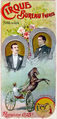
Joseph & Paul Bureau (c.1900)
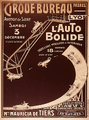
Poster featuring Mauricia de Thiers (1904)
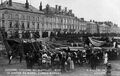
Cirque Bureau destroyed by a cyclone (1905)

Robert, Marguerite, and Anna Bureau-Ferroni (c.1905)
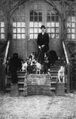
Jules Glasner (c.1910)
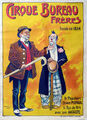
Poster featuring Paul Bureau (c.1910)
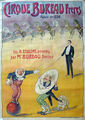
Poster featuring Joseph Bureau (c.1910)
Program Cover (1930)

Poster featuring Les Kimris (1930)
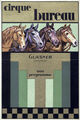
Program Cover (c.1935)
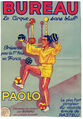
Poster featuring Paolo Bedini (1936)
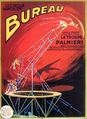
Poster featuring the Palmiri Family (1937)
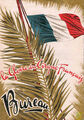
Progran Cover (1946)
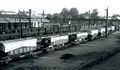
The Circus Train (1946)
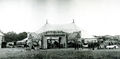
Cirque Bureau (1946)
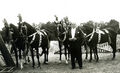
Jules Glasner (1946)
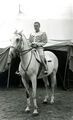
Octave De Pessemier (1946)
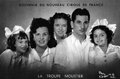
The Moustier Family (1947)
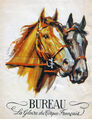
Program Cover (1948)
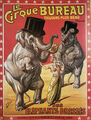
Poster by Gustave Soury (1949)
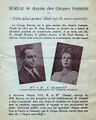
Jules and Anna Glasner (1948)
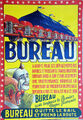
Poster announcing the road transportation (1951)
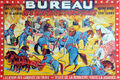
Poster advertising Les Chavaux Pompiers (1951)
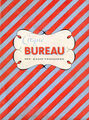
Program Cover for the RTF tour (1952)
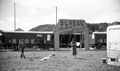
Cirque Bureau setup (1953)
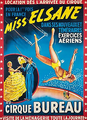
Poster featuring Elsane (1953)
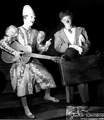
Rex & Quito (c.1955)
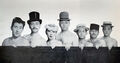
Les Branquignols (1958)
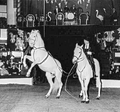
André Vasserot (c.1970)


