Farrell Brothers
From Circopedia

High Wire
By Mary Hettig
The Farrell Brothers were, from 1971 to 1983, a very successful American high wireA tight, heavy metallic cable placed high above the ground, on which wire walkers do crossings and various acrobatic exercises. Not to be confused with a tight wire. duo that followed in the footsteps of Mendez and Seitz (Gene Mendez and Joe Seitz), former members of the legendary Wallenda troupe, in the 1960s. The Farrell Brothers quickly became circus headliners in the United States and in Europe and enjoyed a brilliant, albeit relatively short, international career.
Farrell and The Wallendas
Farrell Hettig didn't come from a circus family. Born in St Petersburg, Florida, on September 25,1955 to Nila and Farrell Hettig Sr., he joined a blended family of three siblings: Beth and Woodie, his older sister and brother from Nila’s previous marriage, and Mary, who was roughly one year older than Farrell. Farrell senior was working in radio advertising and Nila was a homemaker.
Nila and Farrell divorced in 1961, when Farrell was six years old. Then, Nila and the children moved to Sarasota, Florida, known as America’s "Circus City:" John Ringling had made Sarasota his winter home in 1926, followed by his large circus operation in 1927. Over the years, many circus artists and families settled in Sarasota, establishing a circus community that has remained an important part of the city's fabric(See: Tissu) up to this day (2026).
Farrell got his introduction to the circus arts when he joined Sarasota’s famous youth circus, Sailor Circus (today part of the Circus Arts Conservatory), in his teen years. Over the years he performed many acts in Sailor Circus's shows, but high wireA tight, heavy metallic cable placed high above the ground, on which wire walkers do crossings and various acrobatic exercises. Not to be confused with a tight wire. soon became his focus: He was coached by no less than Gunther Wallenda. (Gunther was the one performer of the Wallenda troupe who remained standing on the wire during their tragic fall of 1969.)
At the time, Gunther was a teacher in Sarasota County Schools. A gifted circus student, Farrell eventually went on the road with the Wallendas as a rigger during the summer of 1971. He was sixteen years old. Later in the early 1970’s, he began traveling with them as a performing member of the troupe. During that time Farrell and the legendary head of the troupe, Karl Wallenda, formed a strong bond that would bolster Farrell throughout his life.
In the 1978 television movie The Great Wallendas, Farrell’s skills were prominently featured. Although none of the original Wallendas performed in the movie, they had been impersonated by talented high-wire walkers: Terry Troffer and his wife Delilah Wallenda, Luis Murrillo, David Klukow, Tino and Ricky Wallenda, and a 22-year-old Farrell Hettig. In the re-creation of the dangerous seven-person pyramid, Farrell stood in the crucial position of second tier of the three-tiered pyramid. Less than a year after the completion of the movie, on March 22, 1978, Farrell was present in San Juan, Puerto Rico, when the great Karl Wallenda tragically performed his last walk on the high wireA tight, heavy metallic cable placed high above the ground, on which wire walkers do crossings and various acrobatic exercises. Not to be confused with a tight wire. and fell to his death.
Enter Richard Schmitt
Meanwhile, Farrell had decided to go his own way and create a new high-wire act, a duo in the dynamic and spectacular style originated by Mendez & Seitz. But to do so, Farrell needed a partner. It is at this point that Richard Schmitt entered the scene…
A native of Boston, Massachusetts, Richard Schmitt spent his childhood in Boston and Rhode Island. Like Farrell, he did not come from a circus family: He left home in his teens and describes himself as a "runaway." He recalls his first encounter with the circus world this way: "At age eighteen I found, by sheer happenstance, the Ringing Circus train parked in a filthy trainyard in Providence, Rhode Island. I got a job selling cotton candy and as you might expect ended up in Sarasota, Florida. I had never been there before, loved it, and in my heart, I never really left it.”
In that circus environment, Richard discovered the high wireA tight, heavy metallic cable placed high above the ground, on which wire walkers do crossings and various acrobatic exercises. Not to be confused with a tight wire.. He had never walked on a wire before and taught himself by trial and error. Then he found a partner, Julian Albulet. Julian had previously worked on the high wireA tight, heavy metallic cable placed high above the ground, on which wire walkers do crossings and various acrobatic exercises. Not to be confused with a tight wire. with Mike Talamantez as the Albulet Brothers, an act that will eventually have a long run in Las Vegas at Circus Circus Hotel and Casino. For a short while, Richard became the second half of the Albulet Brothers.
In 1975, Julian and Richard set up their rigging in Sarasota. This caught the local performers' attention, always interested in the work of their circus colleagues. One of those performers was Farrell who, at that point, was determined to develop his own act and was looking for a partner of his caliber. Richard's skills impressed him enough and he and Richard joined forces: Their act was born that same year, and Farrell, not averse to circus hype, named it "The Fabulous Farrell Brothers."
The Farrell Brothers
Their act was outstanding and included all the most spectacular (and dangerous) tricks of the repertoire, such as a two-man height column with Farrell jumping down to the wire from the shoulders of Richard or leapfrogging over him, and fast-speed rope jumping, with all the staged "near-misses" (known as chiqués) that made the act even more nerve-racking. Like his predecessors Harold Alzana, Gene Mendez and Pedro Carillo, Farrell worked without a balancing pole and the act was performed without a net.
Farrell also revived a feature then still uncommon among his contemporaries: Like Harold Alzana (who had retired in the early 1970s), he walked up to and down from the high wireA tight, heavy metallic cable placed high above the ground, on which wire walkers do crossings and various acrobatic exercises. Not to be confused with a tight wire. on an incline wire. He even established a new world record in 1981 for walking the steepest incline high wireA tight, heavy metallic cable placed high above the ground, on which wire walkers do crossings and various acrobatic exercises. Not to be confused with a tight wire.. The Farrell Brothers were young, energetic and good-looking, and their act had all the elements needed to make them genuine circus stars.
This quickly caught the attention of Irvin Feld the owner and producer of Ringling Bros. and Barnum & Bailey Circus and of its brand new (and short-lived) Florida theme park, Circus World, in Haines City, near Orlando. One of its attractions was a "Circus Showcase" that needed high-caliber acts; the Fabulous Farrell Brothers were a perfect addition to the show, and they spent the 1977 and 1978 seasons as a featured act at Circus World.
Following their success there, Irving Feld sent them in December 1979 to the 6th International Circus Festival of Monte Carlo, where they won the prestigious Silver Clown award. Then, Feld sent them on tour in 1980 with his all-star circus production, Monte Carlo Circus Spectacular, which visited Australia, Japan and the Far East with a superb selection of Monte Carlo award winners; the Fabulous Farrell Brothers were now established international circus stars!
Upon their return in 1980, they participated in the Circus World Championships in London, a BBC television event which, like the Monte Carlo festival, was broadcast all over Europe. Then, for the 1981 season, they were featured in one of the world's most prestigious circuses, the renowned Circus Knie in Switzerland. The Farrell Brothers returned to the U.S. in 1982 and performed with the Royal Hanneford Circus in their 1982-1983 season. They gave their last performance with them in Detroit, Michigan.
After the Applause
Farrell and Richard had an amazing career: In a short period of time, they had won one the circus world's most coveted awards, they had toured the world, performed with prestigious shows and, perhaps more importantly, they were still young and had survived a dangerous act without a scar. Farrell and Richard called it quits and parted amicably. They remained in touch throughout their lives.
Richard went on to be a teacher and became a professor at West Virginia's Wesleyan College in its Low-Residency Master of Fine Arts program. He also penned two books: The Aerialist a novel published in 2000, and later, Life Among Strangers a collection of short stories (2019). He retired from teaching in 2020 and now divides his time between his homes in New York and Florida.
Shortly after leaving the circus, Farrell met Kate German and they happily married in 1988. They had two children, Brooke and Mark. Farrell, who always had a head for numbers, enjoyed financial success as a business owner of several "Fantastic Sam" hair salons in Pinellas County, Florida. Sadly, he had an untimely and ironic death: After astounding the world with his daring performances, he died in his sleep from a heart attack on August 22, 2006, at the too young age of fifty.
The Hettig circus dynasty, however, didn't die with him: his niece, Rikki Hettig-Rolfe Meaux grew up in Sarasota and, inspired by her uncle Farrell, performed in the Sailor Circus from the first through the twelfth grades. She is now an educator and a second-generation professional circus artist.
See Also
- Video: The Farrell Brothers, high wire, at the International Circus Festival of Monte Carlo (1979)
- Video: The Farrell Brothers, high wire, at the Circus World Championships (1980)
Image Gallery
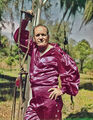
Karl Wallenda (c.1965)
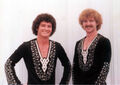
Farrell Hettig & Richard Schmitt (c.1975)
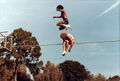
Rehearsing in Florida (c.1976)
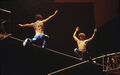
The Farrell Brothers at Circus Knie (1981)
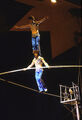
The Farrell Brothers at Circus Knie (1981)
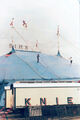
Publicity stunt at Circus Knie (1981)


